
The Access Manifesto – From Lived Experience to Sector-Wide Action
Change in the arts rarely arrives by accident. It comes from lived experience, from frustration, from conversations that refuse to be ignored — and from people prepared to turn those conversations into action.
For Maisy Gordon, The Access Manifesto began with precisely that urgency.
“As a disabled person myself, I have first-hand experience of the barriers disabled people face within the arts,” she says. But it was during her time performing in High Times and Dirty Monsters — a collaboration between 20 Stories High and Graeae Theatre Company — that the scale of the issue crystallised.
Created with, by and for disabled people, High Times and Dirty Monsters toured in 2023, sparking powerful responses from young audiences across the country. Workshops held alongside the production became spaces for honesty. Young Deaf, Disabled and Neurodivergent participants spoke openly about exclusion, underrepresentation and the rare thrill of seeing themselves authentically reflected on stage.
“In the bar after shows, people would come and talk to us,” Gordon recalls. “They’d say it was the first time they’d seen disabled people on stage — and sometimes the first time they’d seen disabled characters played by disabled actors.”
That sense of recognition was powerful. But so too was the realisation that such spaces remain rare.
It became clear that the conversation couldn’t end with the curtain call.
Together with Ayzah Ahmed, Gordon co-wrote The Access Manifesto: a tangible, step-by-step guide designed to help arts organisations, venues and institutions embed accessibility into every level of their practice. Developed from the lived experiences of more than sixty Deaf, Disabled and Neurodivergent young people, the manifesto sets out eight clear action points, supported by practical resources, statistics and implementation tools.
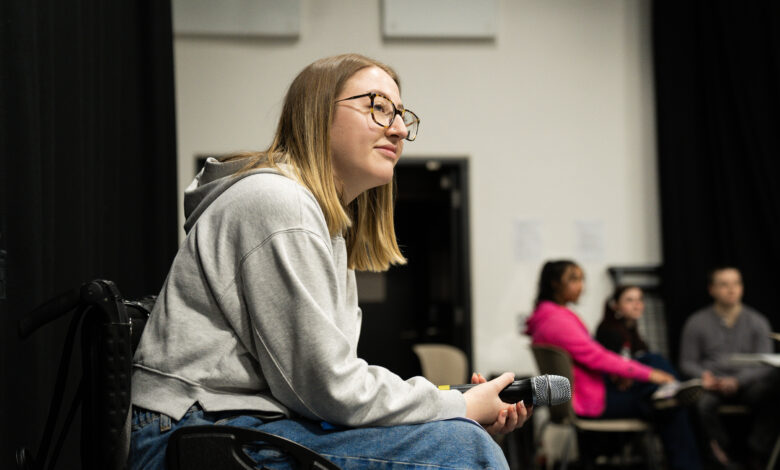
The development process was as important as the outcome. Two national sessions — one in Liverpool, one in London — brought together young people from across the UK. The first half of each session focused on discussion, structured around provocations such as: “I feel welcome at my local theatre” and “I see myself represented on stage, in theatre or film.”
Participants unpacked these statements in small groups before opening the conversation out to the wider room. What emerged was candid and often confronting.
“We spoke honestly about what feels broken, what needs fixing and what real change could look like,” Gordon says.
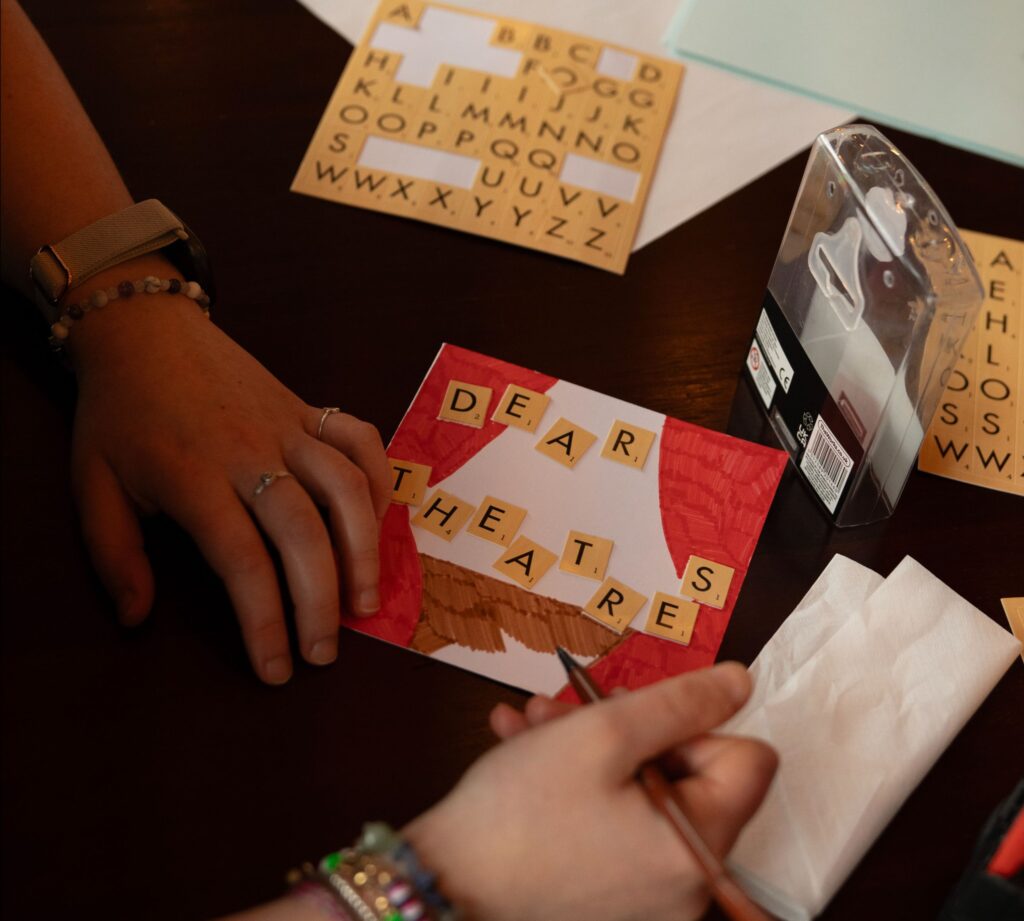
The second half of the sessions shifted into creativity — songwriting, poetry, devising and visual arts. The responses were angry, funny, hopeful and deeply personal. Some challenged the industry directly; others imagined the kinds of spaces young people want to see in the future.
“The creativity and ideas that came out of these sessions felt too important to stay in the room,” she explains. “They were things the arts sector needed to hear.”
The result is not a symbolic document or abstract call for better intentions. The Access Manifesto is deliberately practical. Alongside the eight-point framework sits a “how-to use” guide and an “access tracker,” enabling organisations to map short-term free actions alongside longer-term funded goals.
That practicality is vital in a sector facing financial pressure. Gordon understands the funding landscape — she leads Tip Tray Theatre, a disabled-led theatre company based in Knowsley — and is clear that change does not always begin with capital expenditure.
“I know funding is really difficult,” she says. “Lots of organisations don’t have the money to make structural changes like adding ramps or lifts. But inaccessibility often stems from lack of awareness and stigma.”
She points to research from Scope, which found that three out of four disabled people have experienced negative attitudes or behaviour in the past five years. Assumptions about capability, accusations of exaggeration, subtle exclusion — these attitudinal barriers can be as limiting as physical ones.
For Gordon, the manifesto’s first point, “Open Doors For All”, is therefore the most urgent starting place.
“It’s not about having everything perfect straight away,” she explains. “Access is always changing and improving. It’s about valuing everyone, hearing their feedback and showing that you care — even if you’re still learning.”
That openness, she argues, builds trust.
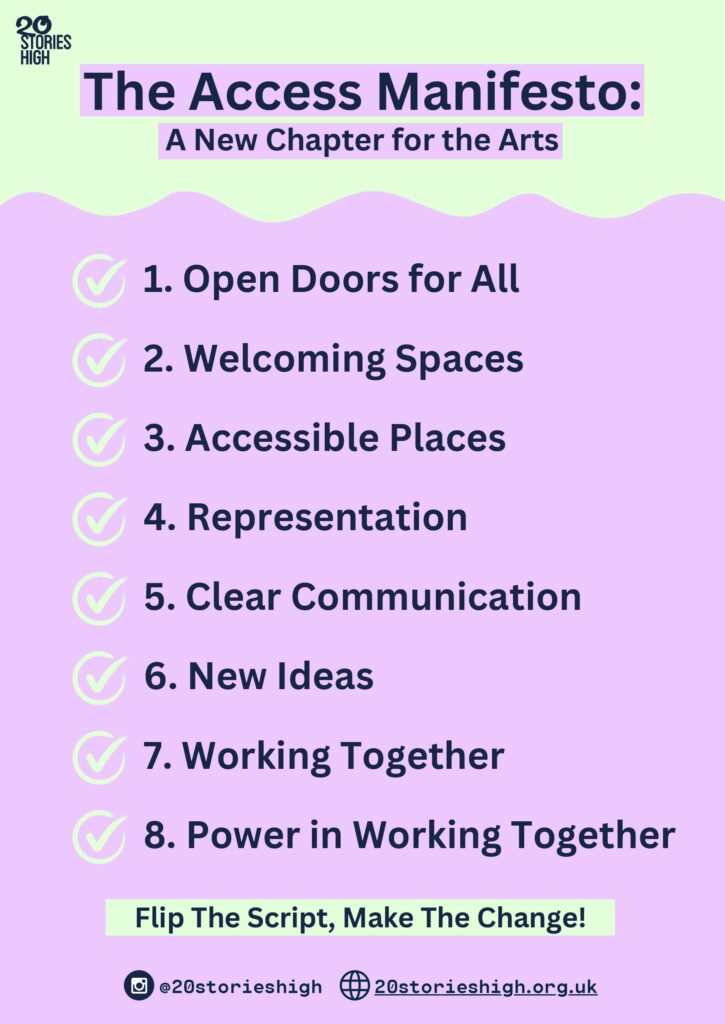
The early response suggests organisations are listening. Since its launch in late 2024, The Access Manifesto has been presented at screening events across the UK, with 26 organisations pledging to adopt its framework.
Liverpool’s Royal Court has introduced relaxed performances and established a Diversity Action Group. The Almeida Theatre is embedding the manifesto within its Young Producers programme. Many venues are increasing provision of captioning, audio description and BSL interpretation. Both Tate Liverpool and Tate London are using the manifesto to inform renovation plans.
These are concrete shifts — not gestures, but structural adjustments.
Yet Gordon is clear that the wider barriers remain systemic. Physical access is still inconsistent. Backstage spaces frequently remain inaccessible. Disabled artists are still expected to adapt to environments not designed with them in mind.
“I’ve been in situations where I couldn’t enter a building or access backstage,” she says. “And I’ve experienced assumptions about my intelligence or capability because of my disability.”
Access, too often, is treated as an add-on rather than something embedded from the beginning.
That philosophy underpins the next stage of Gordon’s work. Through Tip Tray Theatre, she is developing A Space For Us in collaboration with 20 Stories High — a project that zooms in on two manifesto pillars: “Open Doors For All” and “Welcoming Spaces”.
The initiative moves beyond legal compliance to examine lived experience — from the moment someone leaves home to the moment they return.
Research and mapping across the Liverpool City Region will create clear, door-to-door accessibility guides, removing the burden from disabled audiences of having to conduct hours of advance research. Case studies with major venues will explore meaningful improvements at different scales. Four disabled artists will be commissioned to create artistic responses around belonging and community.
The findings will be shared nationally, offering a replicable framework for other regions.
Looking ahead five years, Gordon imagines an arts sector transformed not just structurally, but culturally.
“Access wouldn’t be something added on at the end of a project,” she says. “It would be embedded from the beginning — in programming, casting, recruitment and leadership.”
Disabled artists would hold decision-making roles. Relaxed performances, captioning and BSL would be standard provision. Clear access information would be routine. Disabled audiences would feel not like guests in someone else’s space, but like stakeholders.
“If the manifesto is fully embraced, the change won’t just benefit disabled people,” Gordon says. “It will benefit everyone.”
The Access Manifesto is, at its core, a call for responsibility — and for imagination. It insists that accessibility is not a favour or a feature, but a foundation. And developed here on Merseyside, it is already demonstrating that seismic change can begin locally — when those most affected are trusted to lead it.
However, let us be clear: The Access Manifesto is not a theoretical document — it is a working tool, ready to be used. Arts organisations, freelancers, venues and cultural leaders can download the manifesto, explore the free resources and begin mapping their own access journey today. Change does not require perfection; it requires commitment. By pledging support, opening conversations and embedding accessibility into everyday practice, the sector can move from intention to action.
A new chapter for the arts is already being written — the question now is who is prepared to help shape it?