

Rewriting the Rules: How Rowena Gander Turns the Pole into Power, Memory, and Queer Visibility
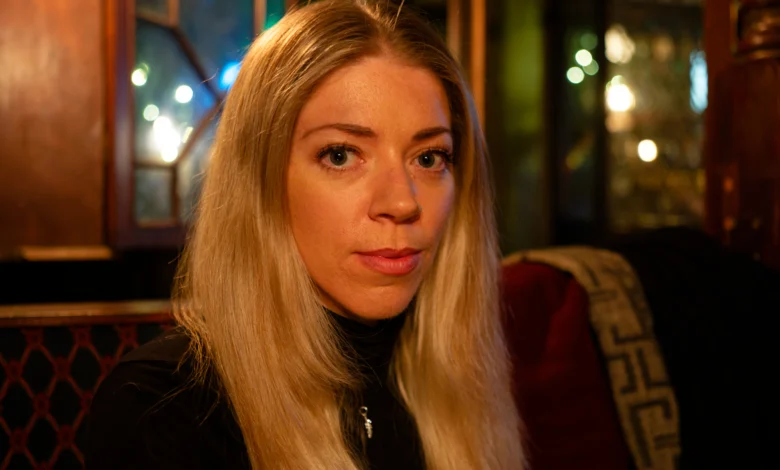
Gander is quietly rewriting what it means to be a queer performer in Liverpool. And she’s doing it from a pole. Not the kind you see in glossy magazines or nightclub corners, but a pole that doubles as memory, as protest, as stage partner, and as research object. Liverpool’s arts scene has always had its heavyweights, but few artists here are doing what Gander does: taking an object steeped in sexualisation and flipping it into something fiercely, unapologetically her own.
Her journey began in clubs across the UK and beyond, where she worked as an erotic dancer. But even then, she was thinking critically about what she was doing. By the time she returned to dance in an academic context, she was asking bigger questions: what does power mean on stage? How does a lesbian performer negotiate visibility, objectification, and desire? And what could a pole actually carry beyond its physicality?
“The first work I created, Does This Pole Make Me Look Straight?, allowed me to explore my relationship with my lesbian sexuality,” she says. “It was then that I started to see the pole as an object capable of metamorphosis, carrying multiple symbolic meanings: a memory, a person, a source of protection, or even something harmful or exploitative.”
That negotiation of the pole’s sexualised history is always present in Gander’s work, but she refuses to be confined by it. “I go far beyond that history and now bring whatever meaning I choose to the object,” she says. Alone with the pole, no audience watching, the work becomes about autonomy, choice, and the truth of embodied experience. “Choice also comes into question in my performance work because I wear many hats: director, choreographer, producer, writer, performer. Artistically, I feel most free, because I can reframe a situation that’s already taken place by making different choices.”
Humour and reflection thread through her performances, a necessary counterbalance to the heavy, personal subject matter. “I learned early on those heavy topics, especially in (semi)autobiographical work, need moments of humour to avoid becoming a self indulgent pity party,” she explains. Improvisation is central to her process: if a movement, a beat, or a gesture feels funny—physically strange or verbally resonant—she keeps it.
Shows like Barely Visible are brutal, hilarious, tender, and confrontational all at once, reflecting the way Gander navigates the world. Critics have called it “raw and funny in equal measure,” and audiences respond to the honesty of it.
Her commitment to research elevates her practice beyond performance. Research is central for her. “I don’t want to create work that positions me as the only person who has experienced something difficult,” she says. She reflects on her own experiences, but also speaks to others, reads widely, and observes deeply before building the work around the strongest themes.
Her PhD codified methodologies for performing with “stigmatized objects,” showing how pole dance can be reclaimed and re-signified—not as a superficial gesture of empowerment, but as a deliberate practice of queer embodiment. Projects like Woman|Women take this further, repeating a mini creative process with a new female performer before each show, exploring attachment, detachment, and how energy can be managed both directorially and performatively. And this is her project that we can now take a closer look at…
How did Woman|Women first take shape? Was there a particular moment, image, or conversation that sparked the idea?
Woman|Women grew out of many conversations with audiences during my national tour of Barely Visible, which explored common issues faced by gay women. There was a clear appetite for more work centred on lesbian experience and I wanted to see that work too.
I’d long been interested in challenging comments that depict two women dancing together onstage as “soft porn.” Lesbian relationships are about far more than sex; like any relationship, they contain longing, attachment, love, loss, self-reflection, triggers, and safety. There is also the difficulty of finding another lesbian, of identifying one without embarrassment or rejection. Aswell as internalised homophobia and its impact on relational dynamics and longevity.
You’ve described your practice as “research in motion.” How did your academic work feed into the creative process for Woman|Women?
“Research in motion” reflects the nature of practice-based research in choreography and performance. The physical practice couldn’t exist without the research, and the research couldn’t exist without the practice. Each feeds the other in a continual cycle. I ask questions about creative process, my agency as a woman, how my sexuality dictates my choices, and how I navigate objectification in performance. I find new things in performance which then provokes more questions.
The show explores the fast-paced nature of lesbian relationships. What drew you to that theme, and why approach it through humour and physicality rather than traditional narrative?
I’ve been an “out” lesbian since I was 15, and I’ve watched many friends fall fast into relationships. The classic “U-Haul” joke—moving in after the first date—still circulates today. I’m guilty of moving fast at times too.
When I researched the phenomenon further, I discovered connections to attachment theory, enmeshment in lesbian relationships, and the idea that a relationship can be the one space where a lesbian feels truly seen and safe—because her partner understands the lesbian experience in ways a heterosexual society often can’t.
What began as a joke revealed a complex emotional undercurrent, which I approached through humour and physicality to keep the work accessible, alive, and embodied.
When you began devising, did text or movement come first? How do you balance spoken word, gesture, and silence?
Text came first, about 80% of the show, followed by improvisation to find movement-based language for the remaining 20%. I manipulated the large structure in tandem with this.
Silence is essential. Audiences need time to process, especially after something intense. In the section where I balance on the steel structure, I stay almost still for about ten minutes, shifting through only a few positions and seven gestures while a reflective voiceover plays. The stillness mirrors the pause required for genuine self-examination, and the precarious balancing reflects the difficulty of that task.
Each venue featured a different local performer. What was your creative rationale, and how did those changing partnerships reshape the work?
Having performed Marina Abramovic’s Imponderabilia at her solo retrospective at The Royal Academy of Arts, a work that says a lot about energetic exchange between performers and audience, I was aware of how another performer’s energy could shape my own. To expand, Imponderabilia consisted of standing naked in a doorway for 60 minutes, whilst mutual gazing with another performer as the audience passed through us. I performed the piece with 12 different people and although the work was the same, the experience was not.
I suspected the same would be true in Woman|Women, and I was right. I’ve now performed with six different women. Their energies have informed the direction, the refinement, and even the emotional temperature of each performance. Every scene is structured the same way, but the results look entirely different.
It’s a creative challenge for me to let go of previous choreography and make space for new dynamics, but it’s also deeply rewarding. What began as a playful comment on the fast pace of lesbian relationships has become something much deeper. I am giving myself space to explore and experience new energies, to learn from how others navigate themes of sexuality on stage. I am also creating space for other LGBT performers to experience transformative shifts too.
You’re known for integrating pole dance and physical theatre. In Woman|Women, how did you choose when to lean into the pole’s language and when to strip it away?
There isn’t a single erect pole in Woman|Women, but rather a structure made of poles. My ten years of advanced pole experience helped me navigate the structure intuitively, knowing its possibilities and limitations.
In earlier work, I used the pole as a fully movable, deconstructable object. Here, I still move, climb, hang, and balance on the structure, but I’m not incorporating its biography in the same way. Its meaning operates differently in this piece.
You’ve called the show “semi-autobiographical.” How do you navigate revealing personal experience while protecting your own privacy—and the privacy of others?
In Woman|Women, I never disclose which parts are autobiographical and which stem from research. That was a conscious, ethical choice to protect the women I’ve had intimate relationships with.
I’m comfortable sharing experiences when I’m the only one affected, but relational ethics matter. I won’t reveal someone else’s struggles without consent. If a theme appears repeatedly in conversations and literature, I may include something personal, because I can contextualise it within broader findings.
You often work with everyday objects. What role did the set or props play in Woman|Women? Did you treat the performance space as a collaborator?
Each prop has a specific meaning. The drill evokes a stereotypical lesbian image while hinting at masculinity on lesbian terms. The large structure is home, confinement, societal expectation, conflict, a box that lesbian couples are placed in. Clothing points to identity—sexuality, domesticity, the way lesbian couples often share clothes, signalling fusion or merging.
Now that Woman|Women has toured to several venues, how has the work changed? Did moments evolve in response to audience energy or context?
The work inevitably changes, particularly with each new performer. The more I revisit the solo parts, the more secure and detailed my performance becomes. Audience validation has also shaped this confidence; from the first outing, the work was warmly received, so there’s no fear of “too much” or “too little.”
There’s a moment where I bring an audience member onstage, which allows the energy to shift every time. It takes enormous courage to volunteer in a piece you’ve only just seen. Hugging them at the end and saying, “thank you” is always incredibly special.
Does Woman|Women close a chapter in your artistic research, or open a new one? How might what you discovered here feed into your next piece?
Woman|Women has fuelled a book chapter on staging lesbianism (to be released in late 2026) and continues to refine my directing, choreographic, and performance practices.
With an interest in durational performance, I’m aiming to reach 24 performances of Woman|Women, to create a 24-hour durational version that repeats hourly with a different performer each time. In durational performance, there is the undeniable presence of fatigue, and I am interested by how exhaustion will shape my choices with each woman…
Liverpool isn’t just her home base—this town can also be seen as a statement. The northern arts scene doesn’t always get the coverage it deserves, but Rowena Gander proves that world-class, challenging, queer-centric work can thrive outside London. Her tours take the work across the UK and internationally, showing that cutting-edge contemporary performance, rigorous research, and experimental choreography aren’t confined to capital-city stages. And in doing so, she challenges structural invisibility: of LGBTQ+ voices, of women’s work, of non-traditional performance forms.
For younger queer artists, her message is clear: “You deserve to be here as much as anyone. If you have the creativity and power to bring something to life—especially something that could positively impact others—let that be your motivation to take up space, even when it’s hard or you face rejection.” She doesn’t sugarcoat it: visibility takes courage, persistence, and belief in the value of your own story.
Gander’s work refuses to settle for easy consumption. Her pole is never just a prop—it’s a question, a partner, a challenge. She interrogates its history and her own identity with every movement, showing that sexuality, objectification, and agency can coexist on stage without contradiction. Her work exposes the assumptions audiences bring and flips them back in real time. In her hands, a pole can be memory, resistance, and manifesto, all in one.
Rowena Gander doesn’t just perform—she redefines what performance can be. Every movement on her pole interrogates visibility, power, and desire, transforming an object long associated with sexualisation into one of memory, agency, and artistic expression. Funny, brutal, tender, and fearless, she stakes space for queer women and overlooked voices, confronting the messy realities of identity head-on. Woman|Women is a striking example of world-class performance and theatre: bold, uncompromising, and utterly unmissable. Her work isn’t just performance—it’s a manifesto, a challenge, and a claim to space, proving that queer, intelligent, and fearless art can thrive on its own terms, anywhere.
To find out more about Rowena Gander visit rowenagander.com and follow @rowenagander on Instagram.