
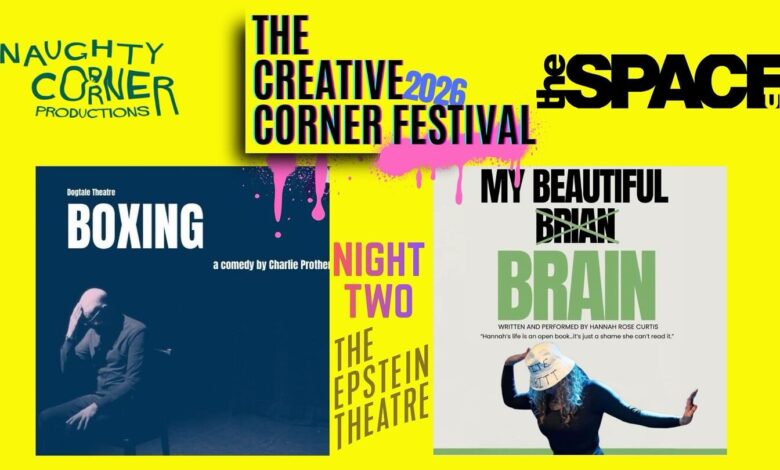
On the second evening of the Creative Corner Festival, the stage of the Epstein Theatre played host to two sharply contrasting pieces of new writing, each offering a glimpse of emerging theatrical voices still in the process of shaping their craft.
Presented in partnership with Naughty Corner Productions, the festival positions itself as a space for experimentation—an opportunity for writers and performers to test ideas in front of a live audience. Night two demonstrated both the risks and rewards of that approach, pairing a darkly comic character piece with an intimate autobiographical performance.
Boxing – Dogtale Theatre
The evening opened with Boxing, a new work from Dogtale Theatre. At first glance, the play appears to set up a familiar comic pairing: the disillusioned authority figure and the chaotic outsider. Yet the script quickly reveals a more complex dynamic beneath its deceptively simple premise.
At its centre is Father Garvey, a priest who seems quietly exhausted by the demands of faith, responsibility, and perhaps life itself. His opposite number is Michael, an energetic young man whose relentless optimism is both endearing and faintly alarming. Their unlikely bond forms the backbone of the piece, with the tension between Garvey’s weary restraint and Michael’s impulsive enthusiasm providing much of the comedy.
The plot is set in motion when Garvey, provoked by a persistently hostile neighbour, makes the kind of ill-judged decision that can only escalate matters further. What begins as a moment of frustration quickly spirals into a series of awkward consequences, pushing the two men into increasingly absurd territory.
Dogtale Theatre’s writing is strongest when it focuses on character rather than situation. The humour grows naturally from the uneasy chemistry between the two men, rather than relying on overt punchlines. Beneath the comic surface runs a more reflective thread about loneliness, faith, and the small acts of desperation that can arise when someone feels cornered by circumstance.
Though still rough around the edges, Boxing shows considerable promise. Its dialogue has an ear for conversational rhythm, and its emotional core prevents the darker humour from tipping into cynicism. With further development, the piece could evolve into a sharply observed study of friendship formed in unlikely places.
My Beautiful Brain – Hannah Rose Curtis
The tone shifted considerably with eventual festival winner My Beautiful Brain, written and performed by Hannah Rose Curtis. Where Boxing leans on fictional character dynamics, Curtis’s work is firmly rooted in personal experience, offering a candid reflection on life with Dyslexia.
Autobiographical theatre can often struggle to balance personal storytelling with wider relevance, but Curtis approaches the subject with a lightness of touch that invites the audience into her world rather than simply describing it. Through anecdotes drawn from childhood, education and adult life, she charts the frustrations that can arise when navigating a society built around conventional patterns of reading and comprehension.
Yet the performance never lingers in complaint. Instead, Curtis frames dyslexia as a different cognitive perspective—one that can produce creativity, lateral thinking and unexpected insight. Moments of humour are interwoven with passages of genuine vulnerability, allowing the piece to shift comfortably between stand-up-like storytelling and quieter reflection.
Curtis proves an engaging stage presence, delivering her story with warmth and self-awareness. The simplicity of the performance style works in its favour, allowing the focus to remain firmly on the narrative and the perspective it offers. In doing so, My Beautiful Brain becomes not just a personal account, but a broader meditation on difference, identity and the ways in which people learn to value the traits that once made them feel out of place.
A Platform for New Voices
Taken together, the two works on display during Night 2 illustrate the variety of voices the Creative Corner Festival hopes to champion. Boxing offers a darkly comic exploration of human frailty, while My Beautiful Brain presents an intimate and uplifting personal narrative.
Both pieces are clearly still evolving, yet that sense of development is precisely what makes festivals like this valuable. By providing a platform for emerging artists to experiment and refine their work, the Creative Corner Festival is helping to nurture the next generation of theatre-makers in the region.
If the quality and ambition shown across this second evening are any indication, the festival is already beginning to establish itself as a welcome addition to Liverpool’s cultural landscape—and a promising proving ground for new writing.