

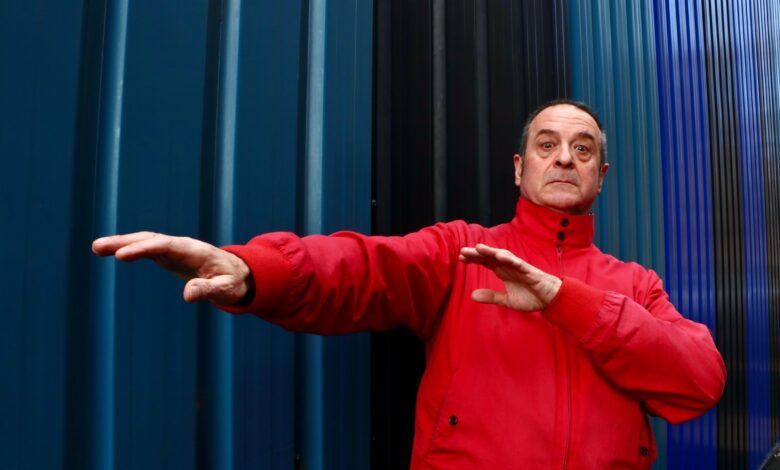
At 22, Mark Thomas wasn’t thinking about where he might be in 40 years. He was thinking about doing as much stand-up as possible, keeping his day job working on a building site with his dad and, when pressed to contemplate the distant future, apparently imagining himself “dead in a hot tub.” Four decades later, the hot tub has thankfully failed to materialise, while the comedy career has expanded into something considerably bigger, stranger and more consequential than even the most ambitious 22- year-old might reasonably have planned.
Thomas brings 40 in Stand-Up Years to Liverpool on Friday 20 November, a show that looks back across a career in which comedy, campaigning, journalism, theatre and political activism have become almost impossible to separate. The statistics alone are formidable: eight awards for performing, four for human rights work, six books, numerous television and radio series, three successful legal actions against the police and a Guinness World Record for staging 20 protests in 24 hours. He has walked 724km along the Israel Wall in the West Bank, campaigned on tax avoidance and workers’ rights and helped establish a comedy club in Palestine. The show’s publicity describes all this as “political and personal mayhem”, an attempt to turn the perennial question of what the fuck is going on into something resembling a coherent evening of stand-up.
Looking back, however, Thomas has little time for the idea that any of it was mapped out. He remembers contemporaries on the alternative cabaret circuit talking earnestly about ten-year plans, something he likens to becoming their own “personal wellness Mao Zedong”. His own philosophy appears to have involved considerably more improvisation. Forty years later, retirement doesn’t seem to have entered the equation either. Ask whether that extraordinary list of achievements ever makes him think he should sit down for a while and the answer is emphatic: stop creating and working, he suggests, and you’re left with soup for lunch and bridge nights…
The anger hasn’t disappeared either, although what provokes and accompanies it has changed. Thomas still talks about wealth inequality, climate change and the horrors taking place around the world, but age has brought another set of responsibilities into focus. For several years he has been a part-time carer for his mother, alongside his sister, and that experience forms part of the new show. The grand political battles now coexist with the very immediate business of ensuring someone he loves has the correct combination of cushions and pillows to settle down in front of 24 Hours in A&E.
It is a revealing shift, not away from the political but towards an understanding that the political and personal were probably never as separate as they appeared. Thomas says he couldn’t disentangle the different elements of his life and work even if he wanted to. Comedy has taken him into campaigns, campaigns have become shows, and shows have occasionally become part of campaigns themselves.
He recalls Dambusters, his show about the campaign against the Ilısu Dam project in Turkey, which threatened the displacement of tens of thousands of Kurdish people. Thomas had already spent several years involved in the campaign, working alongside environmentalists, trade unionists, human rights activists and Kurdish groups. The stage show became another part of that activity, telling its story while inviting audiences to become involved. For Thomas, that remains an example of comedy functioning not simply as commentary on events, but as a tactic within them.
Yet one of his most affecting examples of what performance and storytelling can achieve comes from somewhere much closer to home.
During the Covid lockdowns, Thomas combined his own experience of caring for his mother with conversations with people working across the NHS and care sector. It was a project supported by the Wellcome Foundation. His days were spent looking after his mum and keeping their household going; evenings were given over to conversations with nurses, doctors, surgeons, hospital managers, care-home staff and union representatives. People talked about what they had witnessed, their fear, anger and exhaustion, and sometimes about emotions they felt unable to express anywhere else.
That project carries a particular resonance for this writer. My wife Sophie, also a nurse, was one of the NHS staff who spoke to Thomas. Like many people working through that extraordinary period, we came home from our respective jobs and simply carried on. Despite both being nurses, we didn’t really talk to each other about what we were experiencing. The first time I fully understood some of what Sophie had been through was not across our kitchen table, but listening to her talk about it on Mark’s podcast.
Perhaps that says something about what Thomas was able to create. The conversations became an oral history of workers living through Covid, but they also provided somewhere for people to articulate experiences they had been carrying privately. One care-home head of nursing eventually told him: “You have become my therapist.” Thomas describes being allowed into those conversations as a privilege and distils the lesson into one characteristically direct observation: “Connection with each other is as vital as breathing, my love.” It also explains why, after television, radio, podcasts, books and everything else, he remains so attached to standing in front of an audience.
For Thomas, live comedy is valuable partly because it disappears. A joke is told, the audience laughs, and everyone moves immediately to the next moment. He remembers improvisations that could only ever have worked once, for that particular group of strangers in that particular room. Television and radio can record a performance, he argues, but they cannot recreate that relationship between performer and audience. The recording is inevitably an imitation of something that has already vanished.
Forty years after first picking up a microphone, perhaps that impermanence is part of what keeps Thomas returning to it. The world has certainly provided him with no shortage of material, while getting older has seemingly broadened rather than softened his perspective. Politics remains there, alongside campaigning, outrage and a determination to question those holding power, but increasingly so do family, memory, caring and the smaller negotiations of everyday life.
Trying to squeeze all of that into a single evening sounds ambitious. Then again, Thomas has spent much of the last four decades refusing to recognise the boundary between things that supposedly belong together and things that don’t.
So what should Liverpool expect when 40 in Stand-Up Years arrives in November? After ten questions about politics, activism, ageing, Covid, caring, human connection and four decades spent attempting to understand an increasingly bewildering world, Thomas reduces the whole enterprise to the following – “Stories, gags, rants and silliness.”
Which, after 40 years, may still be the best manifesto he’s ever written.
Mark Thomas: 40 In Stand-Up Years
Friday 20 November 2026
Liverpool Playhouse
Tickets