

A sumptuous revival of Nureyev’s enduring tragedy.
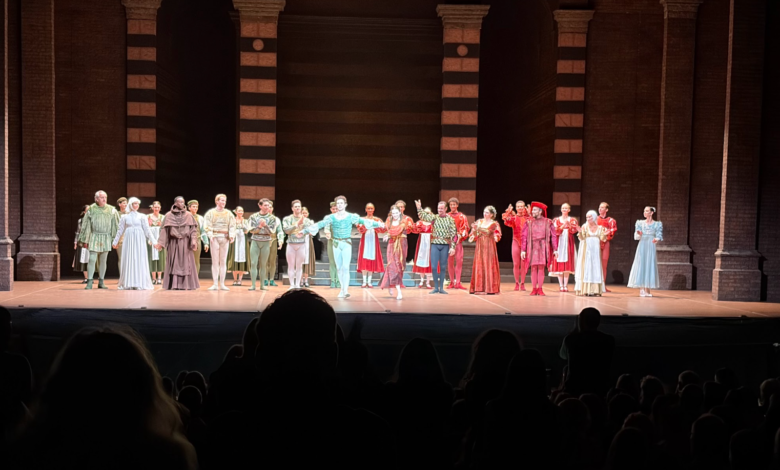
A sumptuous feast for the eyes and ears, English National Ballet’s revival of Rudolf Nureyev’s Romeo & Juliet brings together the pleasures of a luxurious stage picture, Prokofiev’s magnificent score and dancing whose dramatic conviction makes a familiar tragedy feel compelling once more. And with Liverpool Empire playing host, this is an evening in which the scale of the production and the intimacy of its central relationship work beautifully together.
Nearly fifty years after its first performance, Nureyev’s production retains a remarkable vitality. Shakespeare’s Verona provides a world of public confrontation and private longing, where the bustle of the market square and the entrenched hostilities of its ruling families leave precious little room for the lovers. The story’s destination may be known, but the quality of its telling makes the journey absorbing.
At its centre, Aitor Arrieta’s Romeo and Emma Hawes’s Juliet share a discernible chemistry which gives the choreography its emotional purpose. Their connection makes the relationship credible, allowing the dancing to communicate the attraction on which everything that follows depends. For all the production’s visual splendour, it is this sense of two people finding one another within a hostile world that holds the attention.
That chemistry also gives the evening an essential balance. A production on this scale needs its central relationship to register through the surrounding activity, and Arrieta and Hawes provide that focus. The choreography gains from the feeling between them, its physical expression carrying the story beyond the simple illustration of a much-loved text.
Gustavo Carvalho deserves particular mention as Mercutio. His comic presence in the market square brings personality and welcome humour to the action, establishing a character whose later fate consequently matters. In Act Two, his convincing death scene changes the emotional temperature of the evening. The contrast between his earlier playfulness and that fatal encounter gives the tragedy a sharper edge, as the violence of Verona closes in.
Hearing Prokofiev’s score performed by an orchestra in the pit is itself a considerable pleasure. Under Music Director and Conductor Maria Seletskaja, the English National Ballet Philharmonic brings the music vividly to life. Its contribution is central to the experience: the score supplies the evening with an emotional force that deepens the drama unfolding above it. The richness of that live sound makes the partnership between music and movement especially rewarding.
Visually, the production is equally generous. The luxurious set design gives Verona substance and atmosphere, while the tasteful, precisely judged lighting lends the stage pictures a painterly quality. Its treatment of light and shadow evokes the spirit of Caravaggio, giving this Italian world a richness that rewards looking beyond the immediate action. The beauty of the setting forms part of the storytelling, drawing the eye into the world the dancers inhabit.
What emerges is a revival whose individual elements serve a coherent dramatic whole. The lovers’ chemistry, Carvalho’s memorable Mercutio, the orchestral performance and the visual design all contribute to an evening of considerable pleasure and emotional weight.
This was a fantastic performance of a superb production. Approaching its fiftieth anniversary, it continues to make an eloquent case for its place on the stage. Again, it’s a sumptuous feast for the eyes and ears — Nureyev’s Romeo & Juliet remains unmissable.
English National Ballet’s Romeo & Juliet continues at Liverpool Empire until Saturday 17 October. Tickets are available via the Liverpool Empire website.