

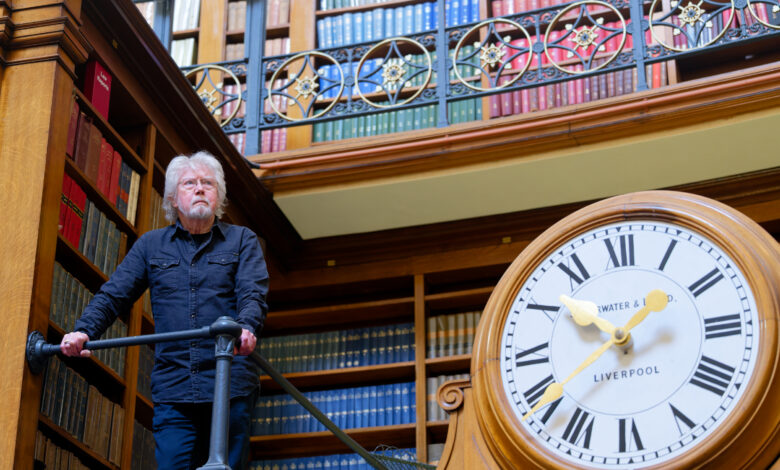
Seán Street: Eighty Years of Curiosity and the Art of Paying Attention…
A four-year-old boy stands in a garden in Wittering, Sussex, as the summer light begins to fade. Beyond the garden is woodland and, from somewhere among the trees, comes a scream. Perhaps a fox, perhaps an owl killing some smaller creature; whatever made it, the boy doesn’t know. What matters is that he hears it, wonders about it, and remembers.
More than seven decades later, Seán Street is sitting in the café at Liverpool’s Walker Art Gallery when something similarly elusive catches his attention. Beneath the everyday noise he becomes aware of the trains passing under the building, less a sound than a vibration, something almost beneath perception. That tiny discovery eventually becomes the opening of an entire book.
Between those two moments lies an extraordinarily varied creative life encompassing poetry, theatre, radio, broadcasting, teaching, academic research and sound art. Yet a conventional chronology only tells part of the story. Street’s work has always seemed more interested in what happens when we stop long enough to notice: a voice, a room, an unexpected silence, the residue of a place or something momentarily heard before it disappears.
Perhaps the writer was always there… Poems appeared in his teens, encouraged by teachers who understood that education could be about considerably more than passing examinations. They introduced him to Shakespeare, Keats, Edward Thomas and Robert Frost, beginning a relationship with literature that would eventually encompass everything from Hardy and Emily Dickinson to Seamus Heaney, Elizabeth Bishop and the ever-present John Clare.
Other doors opened less predictably. Drama school led to seven or eight years in professional theatre; appearing in the West End around 1969-70 led, almost accidentally, to sitting in on a late-night radio programme. Earlier, months spent in Paris as a 21-year-old had provided another kind of awakening: Bruckner in Notre Dame, poets gathering around George Whitman at Shakespeare and Company, first encounters with radio at ORTF. Street returned changed, carrying experiences whose significance would continue to reveal itself long afterwards.
That willingness to follow the unexpected remains important. An overheard conversation, a phrase, a note of music or the almost subliminal rumble beneath an art gallery might be enough. Creativity, for Street, seems less about imposing ideas upon the world than remaining receptive to what the world might unexpectedly offer.
Listening therefore becomes more than an auditory process. He has spent years thinking about the difference between simply hearing something and actually paying attention to it, influenced particularly by Pauline Oliveros and her philosophy of active listening. Carrying a small digital recorder has become part of that discipline, a way of discovering how readily the mind edits the world around us.
While working on The Sound of a Room, he sat quietly in the Picton Room at Liverpool Central Library, noting what appeared to be an almost silent environment. Only afterwards, listening to his recording, did another room reveal itself: the faint pull of Velcro from a backpack, a throat being cleared, the tiny movement of a chair. The recorder had caught everything his brain had quietly decided he didn’t need to hear.
Perhaps that explains why Street’s idea of place is never simply geographical. Liverpool may be his adopted home, but listening to it also means attempting the impossible: imagining the city before he knew it. Somewhere behind the contemporary urban noise are horse-drawn wagons carrying cotton across dockside cobbles, industry, voices and lives whose physical traces have largely vanished. “We walk through haunted streets, surrounded by ghosts,” he observes.
Those ghosts are not confined to cities. While transcribing his father’s handwritten memoirs, Street found himself beginning to hear the voice behind the fading ink. His father had been dead for forty years. Later, somebody reading the resulting poem, Handwritten, observed that Seán might now be the only person capable of imaginatively hearing that particular voice.
This is a quietly unsettling thought, but one that gets close to something fundamental in Street’s work. Memory is fragile, yet a voice can remain inside handwriting; a vanished city can survive in literature; a moment can be held inside a recording. Candlelight, Louis Armstrong’s twelve-second cornet note on West End Blues, recorded in Chicago in 1928, becomes capable of doing away with time altogether. Play it again and, for those twelve seconds, the moment exists once more.
Radio taught Street something else: what isn’t heard can matter just as much. While making a programme about villages lost beneath reservoirs, he walked through the remains of Derwent with Ernest Medley, who had grown up there before the village was submerged. Standing near the foundations of his childhood home, Medley remembered his father’s wall and the pear and apple trees planted alongside it. Then came a pause before two final words: “that grew.” The subsequent silence between the two carried the memory.
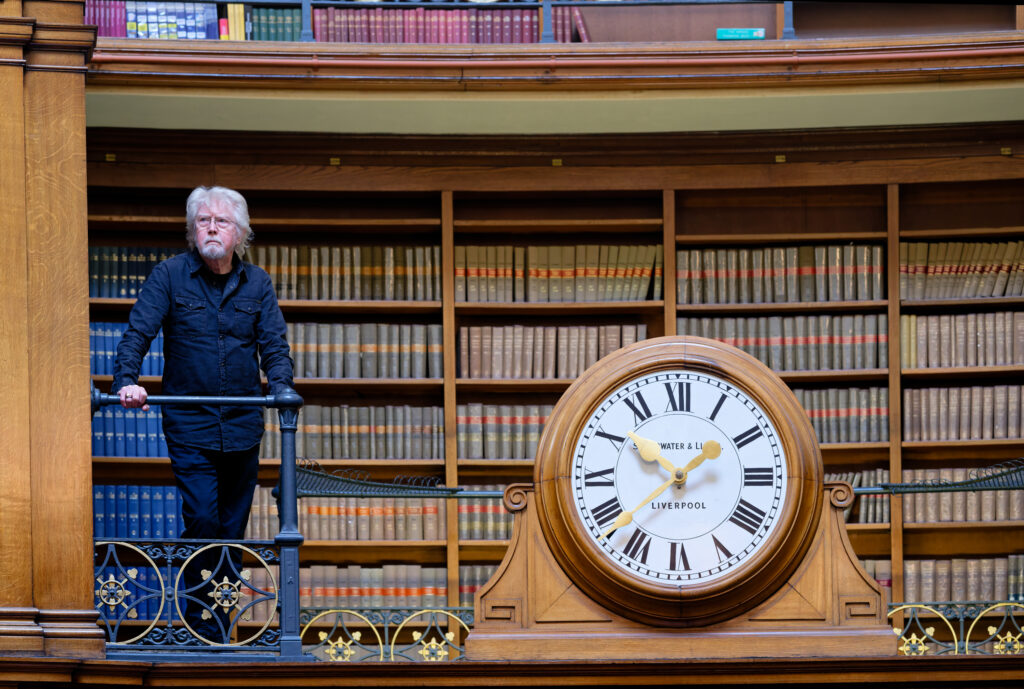
Street has spent a lifetime surrounded by words, but there is something appealing about a writer so conscious of the spaces around them. It may also explain why friendship and collaboration recur so strongly through his creative life. Teachers became formative presences; interviews sometimes became friendships, beginning, as he beautifully puts it, “with a microphone between us”. Writers, broadcasters, musicians and composers have remained part of a continuing conversation, while collaborations with Cecilia McDowall and Merseyside guitarist Neil Campbell have allowed poetry to find different voices and forms.
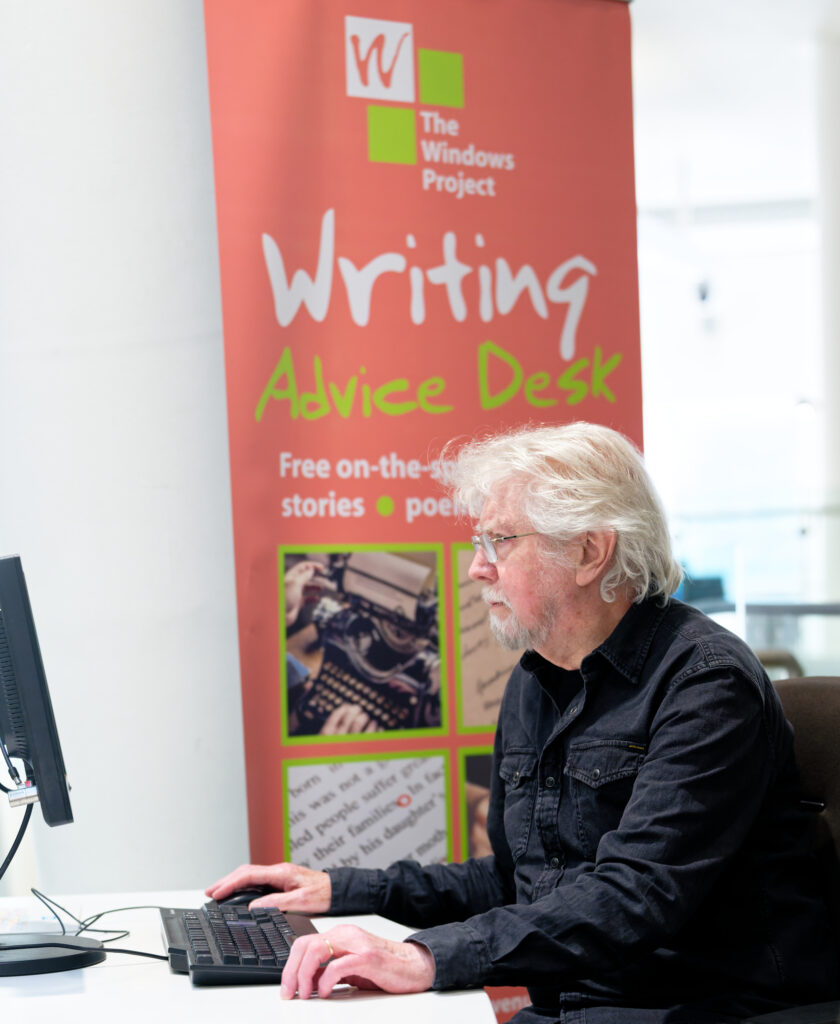
Now, at eighty, Street remains curious rather than retrospective. Time inevitably looks different, “there’s less of it left”, but there is also more freedom to follow an idea simply because it demands following. New work and collaborations continue, including Poetry in a Box, a project involving the Windows Project and Clatterbridge that will use recorded poetry as a stimulus for patients unable to participate in conventional workshops.
For someone so interested in preservation, Street seems remarkably uninterested in standing still. And yet time, friendship, memory and the traces people leave behind inevitably become more resonant as the years accumulate. Those ideas come together with particular intimacy in Threshold, from Street’s 2026 collection Candlelight. Written following a January 2025 visit to his friend of almost fifty years, the poet Jeremy Hooker, it begins with two men meeting again at Dan-y-Lan, Hooker’s home in the south Wales village of Treharris.
What follows is a poem in which very little happens and almost everything matters: conversation, tea and Welsh cakes, books murmuring from another room, the mist lifting outside and, eventually, the closing of a door. Friendship and the passing of time are held within those small details, making Threshold an especially revealing poem through which to consider Street’s work. So, rather than step further between poet and poem, it seems appropriate to let Street explain how it came into being himself…
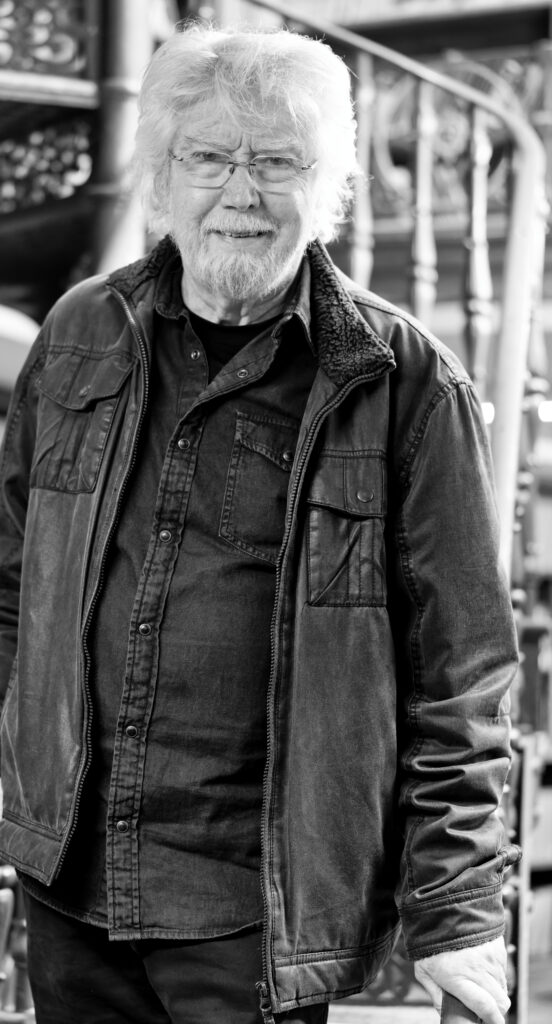
LN: Threshold begins with a very precise sense of place and time: “January and the valley town new year / slowly starting to emerge through fog.” What was happening in your life, or in your relationship with Jeremy Hooker, when this poem began to take shape?
SS: There are two poems in the Candlelight collection – Breakfast with Michael Longley and Threshold – that read with hindsight, seem to be obituary poems. In fact, when both were written, Michael and Jerry were very much alive, and in both cases, the poems formed part of a correspondence between us, so Michael and Jerry got to read and know them, and I’m happy to say, were kind enough to like the poems. Now of course they come to the page loaded with a retrospective bereavement, but it’s important to note that they were not written in that knowledge. Threshold was written in January, 2025, after what turned out to be my last visit to Jeremy Hooker. I was at the time taking part in a conference at Cardiff University. Jerry lived in the village of Treharris, not far from Cardiff; as he was in poor health, we arranged that I would visit him at his home.
LN: “At the unlatched door I call, you answer, / and forty years resume where we left off.” That is a beautiful description of friendship and time. What does “resume” mean to you here? Is the poem partly about the strange way some relationships seem to exist outside ordinary time?
SS: There was a sense that we always just picked up where we left off. It was like that. Maybe because we had weekly phone conversations in which we regularly talked about current literary issues, what we were working on and so forth, plus we’d also taken part in Zoom discussions on panels for conferences between times. But I think you come to a level of familiarity with a friend of a certain level where there are no initial pleasantries: you simply “resume.”
LN: You write, “We have aged together while apart”. It is a deceptively simple line, but it seems to contain much of the emotional heart of the poem. When you wrote it, did you feel you were writing specifically about your friendship with Jeremy, or something more universal about absence, ageing and memory?
SS: It’s us, and it’s universal. Because we are moving in parallel through time, there is no shock of change when we come face to face. We are as we were, relative to one another, in the context of what time has done to us.
LN: There is something wonderfully intimate about the domestic details: tea and Welsh cakes, books “murmuring”, cats, the old house “presences listening”. How important are these apparently ordinary details in allowing the larger themes of the poem to emerge?
SS: These details were and are crucial. Because Jerry wasn’t mobile, he asked me to make some tea. I knew the house from years before, and felt quite at home doing so. His study – which he referred to as a ‘chaos of books’ lay just across the hall, and his two cats followed me around. The significance of this meeting – the fact that, although unstated, we both knew that probably this would be our last hours together – made the intimate domestic details all the more poignant.
LN: “Outside there is time.” It is perhaps the most striking statement in the poem because, until that point, we have been inside a world in which forty years can apparently disappear. Is the house a kind of refuge from time, or is the poem suggesting that memory and friendship create their own sense of time?
SS: While we were together inside Dan-y-Lan nothing was changed between us. Outside there WAS time, my car parked by the cottage, me driving away from the moment, through landscape and time, our friendship consigned to memory, but with the later coming of the poem, preserved in a timeless state that was the definition of our life together.
LN: The ending moves away from the two men and towards the image of “a rowan biding its time” at the window. Why a rowan, and what does “biding its time” mean to you? Did you always know the poem would end there?
SS: The rowan tree stood outside Jerry’s study window. It was a talisman, and a friend to him, a marker of the seasons that had the backdrop of the Treharris valley. During that final conversation, he told me he planned to write a poem about the tree, to explore its importance for him. In fact, this poem, The Rowan Tree, appears in his last book of poems, With a Stranger’s Eyes, published later that year and shortly before his death on Boxing Day, 2025. It’s a long poem, and he ends it thus:
Rowan tree
that enchants my days
be to me, if only
in imagination,
an old man’s staff
Let me stand with you
against Atlantic gales
Allow me to warm myself
with your leaves red glow
against the coming cold.
LN: Finally, Threshold feels to me like a poem about much more than a visit between two old friends. It seems to touch on friendship, ageing, memory, mortality, departure and the persistence of place. What do you think you were really writing about when you wrote it? And has your understanding of the poem changed since you finished it?
SS: I said this was not an obituary poem, as it was written in life. But at the same time, in a way, it is of course, isn’t it? It is also a poem of witness to love between two kindred spirits, words that for both of us needed saying and sharing, a sense of completion, a sort of testimony. Shortly after Candlelight was published, I heard from Jeremy Hooker’s daughter that Dan-y-Lan had been sold to a new owner. For me, this makes the intimacy of the lines, the details held in them, all the more important as an act of preservation. After he died I knew I’d never cross that threshold again, but with Emily’s news of the sale, the idea of being forbidden – a kind of imaginative trespass as well as a brutal signal of closure – made the bereavement doubly real.
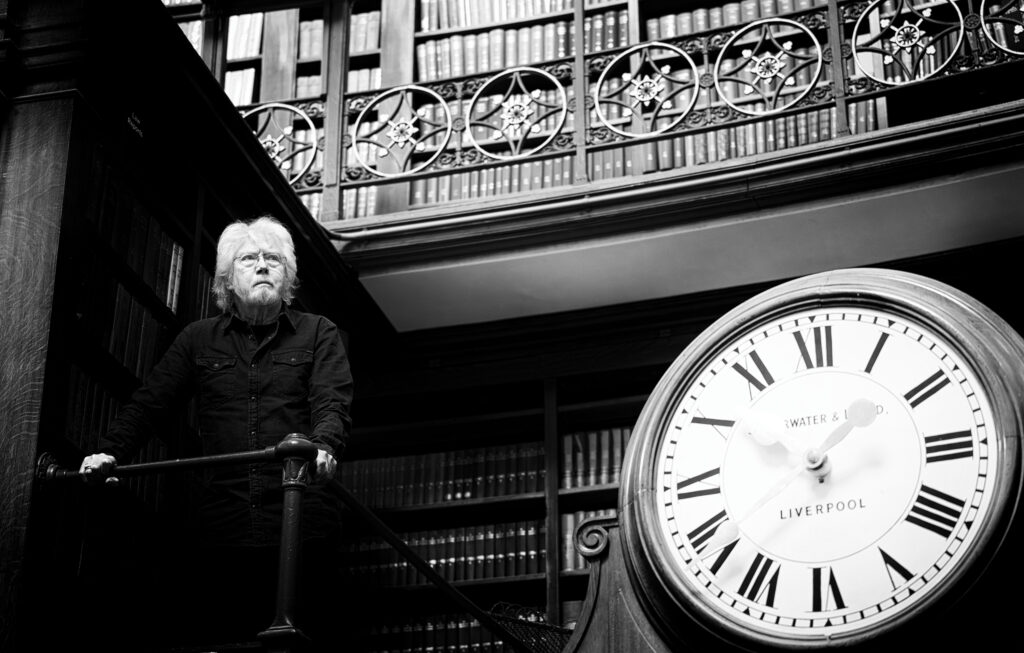
Perhaps the poem Threshold brings us back to what has been there all along: the instinct to notice something while it is still present. A voice, a friendship, a room, a tree outside a window; the things that appear ordinary until time changes their meaning. On a personal note, it is my favourite poem in the Candlelight collection.
Across a career spanning poetry, broadcasting, sound art, teaching and criticism, Street has made that act of attention central to his work. His achievement lies not simply in the considerable body of writing and broadcasting he has produced, but in the connections he has made between disciplines that are too often kept apart. Poetry leads to sound, sound to place, place to memory, and memory back to language. Collaborations with writers, musicians and composers have extended that conversation further, while his work as a teacher and broadcaster has invited others to listen differently too.
That makes Street an important and distinctive poetic voice. He reminds us that poetry doesn’t necessarily begin with grand declarations. It might begin with the creak of a chair, fading handwriting, a train somewhere beneath our feet or the pause before somebody finishes a sentence. His work asks us to become more attentive to the world and to each other, something that feels increasingly valuable amid the noise and distraction of contemporary life.
And crucially, he remains creatively restless. At eighty, Street is still collaborating, recording, questioning and writing, reluctant even now to describe himself simply as “a poet”. Writing well, he insists, remains difficult and the title something to be earned. His ambition is more straightforward: the next poem, and then the one after that.
Which takes us back to the child in Wittering, standing at dusk and wondering about a sound he cannot identify. Seventy-six years later, Seán Street remains alert to what might otherwise pass unnoticed, still curious, still questioning, still listening. Still waiting for what has not yet sounded…
Candlelight can be purchased via the Poetry Book Society.
Instagram: @seanstreet1