

Arthur Miller’s Death of a Salesman remains a powerful and deeply human story, and this production at the Liverpool Everyman delivers a shocking, thought-provoking and often explosive interpretation that brings the classic firmly into the 21st century.
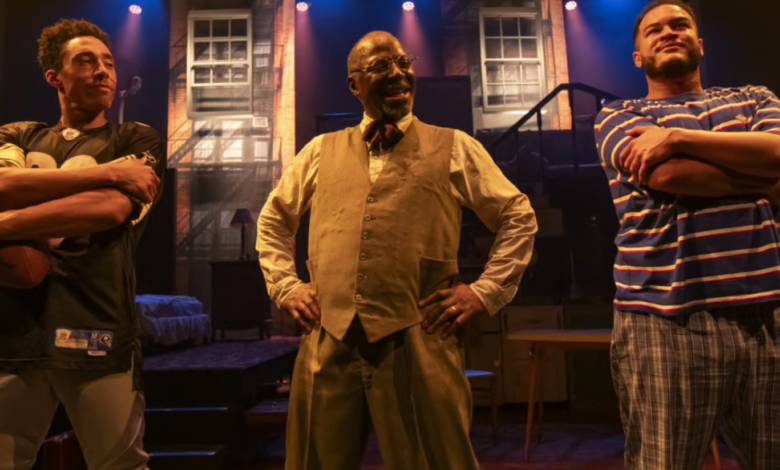
At the heart of the production is the relationship between Willy Loman (Cyril Nri) and his son Biff (Laurence Ubong Williams). Both performances are excellent, with their volatile and complicated relationship providing some of the most compelling moments of the evening. Their clashes feel raw and explosive, while the quieter moments reveal the layers of disappointment, expectation and love that sit underneath their fractured relationship.
The cast consisted of Willy and Biff, Biff’s brother Happy (Kiren Kebaili-Dwyer) and their mother Linda (Emma Cater) demonstrate powerful dramatic skills to portray this family who are teetering on the edge. Supporting characters were also strong and comprised of friends, family from the past and new interactions. Ben (Tayo Aluko) dropped us into Willy’s past, his performance was heavily influenced by robust physical theatre, Charley (Joe Speare) provided the much needed lightness, comic timing and laughter to this over arching dark storyline. Bernard (Noah Olaoye) demonstrated the success which the other characters yearned for, a constant reminder to them throughout. Adelaide Banks switched beautifully between a collection of supporting roles such as ‘The other woman’, ‘flute’ and general supporting characters.
The erratic nature of the production works particularly well in representing Willy’s increasingly chaotic state of mind and his decline. The movement between reality, memory and imagination can feel disorientating, but in many ways that is exactly the point. We are experiencing the world through Willy’s increasingly fractured perspective.
The use of lighting (Stella Okafor-Ross) and sound (Ernest Acquah) is particularly effective, helping to create an event out of the production rather than simply providing atmosphere. Especially, for the bigger scenes and incidents and at times they work together to heighten tension and reinforce the emotional shifts throughout the story. There were times when I could hear a clear background sound, throughout this was not always the case but overall a strong amalgamation of lighting and sound.
The set design (Georgia Wilmot) is relatively simple, but this works in its favour. The use of different levels creates an interesting performance space and allows the staging to remain visually engaging without distracting from the characters.
The physical theatre used to introduce the memories is also effective. However, once the production had established that we were entering a memory, I felt it could have trusted the audience to understand what was happening without continuing to emphasise it quite so heavily. Sometimes less can be more.
The costumes (Georgia Wilmot) are effective, although a subtle visual change to distinguish the past from the present could have made the different time periods easier to follow. Similarly, there were moments when the accents fluctuated, which occasionally distracted from otherwise strong performances.
One of the more intriguing elements is the use of the flute (Adelaide Banks). Its significance within the story is important, but at times its inclusion felt more confusing than illuminating. For an audience member unfamiliar with the symbolism behind it, its purpose wasn’t always immediately clear.
I did really like the symbolism at the end of the performance and the insertion of the strong African culture with the entire cast. However, I would have appreciated this more if I wasn’t ready to head home. This is why I felt parts could have been shortened or removed to emphasise and make other scenes more impactful.
What makes this production particularly interesting is how successfully it brings Miller’s themes into a contemporary setting. The struggles surrounding commission, wages and financial insecurity feel extremely relevant to modern audiences. The inclusion of different cultures, modern-day references and technology helps the story feel less like a piece of theatre trapped in the past and more like a story that could be happening around us today.
Despite occasionally feeling longer than necessary, there is no denying the strength of the storytelling. There are moments where scenes could perhaps have been shortened or elements removed without losing the overall impact. In fact, allowing the story to breathe in those places may have made some of the most powerful moments hit even harder.
But ultimately, this is a production that stays with you.
Shocking, powerful and thought-provoking, Death of a Salesman at the Liverpool Everyman demonstrates why this story has endured. With excellent performances, particularly from Willy and Biff, striking use of sound and lighting, imaginative staging and a contemporary approach to its themes, this production finds new relevance in a familiar classic.
A compelling evening of theatre that asks uncomfortable questions about ambition, family, identity, money and what happens when the dream you’ve built your life around begins to fall apart.
Death of A Salesman runs at the Liverpool Everyman until 10 October. Tickets are available via everymanplayhouse.com/event/death-of-a-salesman.