

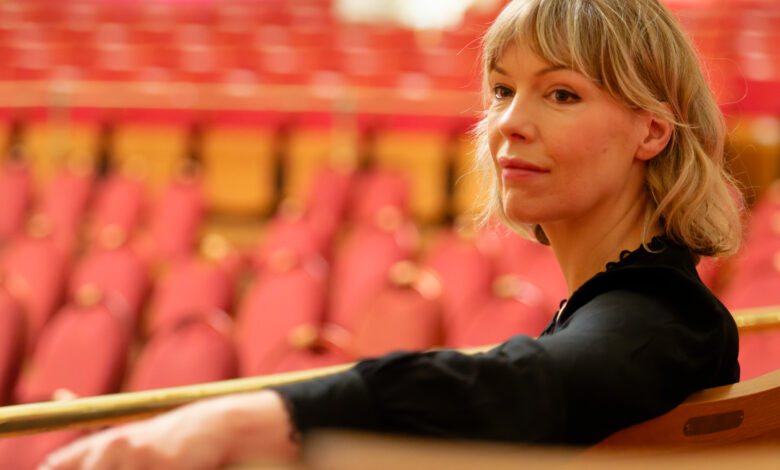
Caroline Gorick – Holding onto the moment…
Caroline Gorick has been painting for as long as she can remember. There is no neat moment of discovery in her story, no sudden realisation that art might become a career, because painting was never really something she decided to do. It was simply there, embedded in her life from childhood onwards, becoming more serious and more demanding as the years passed.
“I haven’t stopped painting since I was a kid,” she tells me. “I’ve always got such a kick out of the creative process in general, but painting for me has everything.” There was, she says, “never really anything else that compared to painting”, and perhaps that goes some way towards explaining both the intensity of her practice and the profound sense of loss that followed when she was eventually forced to step away from it.
After studying Fine Art and Visual Culture in Bristol, Gorick went on to the Royal Academy Schools, where three years of postgraduate study gave her something increasingly rare: time. With a studio in central London, access to galleries, seminars, long critiques and a community of artists and tutors, she was able to take her practice apart and examine what was left.
“I was able to completely deconstruct my practice and then slowly rebuild and refine it,” she says. The experience developed her understanding of contemporary art and, perhaps just as importantly, her understanding of where she herself might sit within it. It was a period of intense development, but Gorick’s relationship with painting would subsequently be tested in a way no art school could have prepared her for.
Around 2012, she became increasingly sensitive to paint fumes and solvents. She experimented with water-based paints and other ways of making work, but nothing quite clicked. Gradually, painting became something she could no longer do in the way she needed to do it. It wasn’t simply a practical inconvenience. For someone who had always understood painting as an integral part of her existence, being unable to paint created a much deeper uncertainty. “It was quite a regretful time, as you can imagine,” she says. “I didn’t give up entirely, but I wasn’t sure I was an artist anymore.”
Then, three years ago, she started again. Initially the paintings were tiny, but the practice quickly expanded. Years of accumulated thought, observation and experience seemed to pour back onto the canvas. “It was like an explosion of all those years onto canvas,” she says.
“It felt incredible. My ideas, thoughts and the painting all seemed to fall into place very quickly. I was back.”
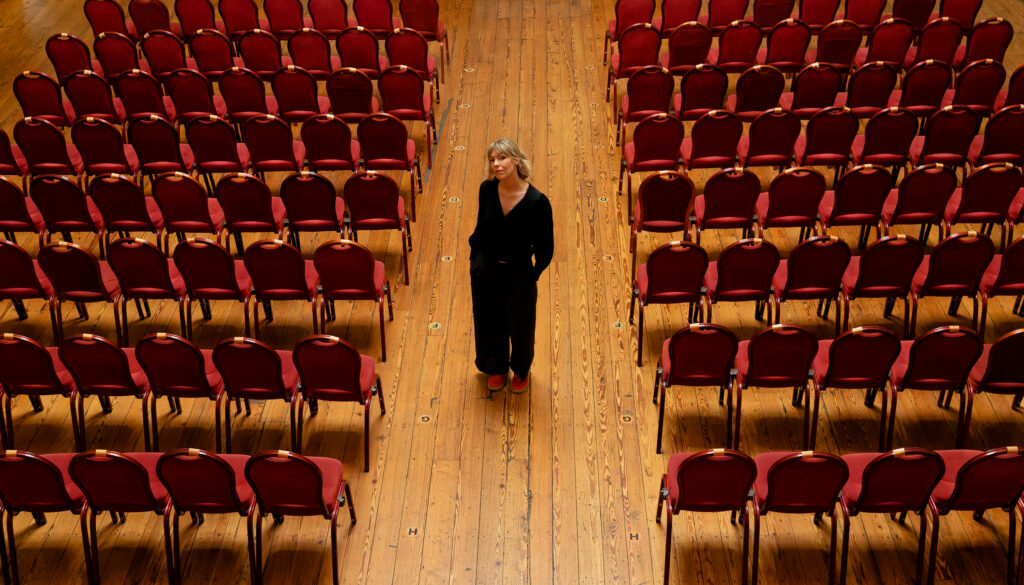
That return is important when looking at Gorick’s current work, because these paintings don’t feel like an artist trying to recreate something she has lost. They feel more like the product of everything that happened in the intervening years. The technique has become more economical and physical, with Gorick working wet-on-wet and completing a painting in a concentrated burst, sometimes over little more than a few hours. She begins with a carefully considered reference image and a clearly drawn form, but from that point onwards the painting becomes a negotiation between control and instinct.
“I know it’s reached its final form when I see something solid,” she explains, “but at the same time, there is a tension, a sort of knife edge, between that solidity and the form dissolving.” And it is that tension that sits at the heart of the work.
Light has become one of Gorick’s recurring subjects, although even that description doesn’t quite tell the whole story. She is less interested in depicting illumination than in using painting to explore what happens when light makes something visible and darkness allows something else to disappear. Her technique is correspondingly unusual: rather than simply applying lighter paint to create illumination, she paints the darker areas and then rubs or paints away pigment, revealing the pale ground beneath. The result is an image that seems to exist somewhere between arrival and disappearance.
Her references are often ordinary things: a lamp, a ceiling light, an interior, an object encountered in everyday life. Yet their very stillness becomes significant. A lamp can remain fixed in exactly the same position while everything around it changes, seconds accumulating unnoticed. Gorick is fascinated by that contradiction — the still object and the relentless movement of time. “I’m interested in the tension between the stillness of the object and the passage of time”.
It is a preoccupation that extends beyond the subject matter into the physical process itself. Her forms emerge and dissolve; brushstrokes are added and removed; decisions are made and then challenged. She photographs paintings during their creation because moments within them can disappear before she has fully registered what has happened.
There is, consequently, something almost paradoxical about the project. Gorick is attempting to hold onto moments that she knows cannot be held, using a process in which the image itself is constantly at risk of changing or vanishing. That helps explain why ambiguity matters so much to her. She wants the viewer to move between recognition and uncertainty, to see a form and then lose it again. “The painting never quite settles,” she says. “It reflects my attempt to hold onto a passing moment that can’t ever actually be held.”
There is also a deeply personal history beneath that interest in images that remain lodged in the mind. Gorick recalls staying at her grandmother’s house as a child and becoming fascinated, alongside her sister, by an enormous hardback book of Goya’s paintings. They knew the figures, the poses and the stories, returning again and again to images ranging from reclining nudes to Saturn Devouring His Son. “Goya never really left,” she says.
Now living in Liverpool, Gorick has found herself surrounded by another kind of artistic community. Moving to the city in 2020 meant arriving during the pandemic, so it took time before she properly encountered the place and its creative life. Once she began connecting with other artists, however, Liverpool opened up to her.
She speaks warmly of the city’s generosity and the network of artists around her, crediting that community with helping her develop the practice she has now. The John Moores Painting Prize has been particularly significant. Having reached the first stage of the competition while living in London, she applied again after several years away and, in 2025, finally saw one of her paintings selected for the exhibition at the Walker Art Gallery. Handing the work over in person carried a particular resonance. Liverpool was no longer simply the destination of the painting; it was home.
And now the work is beginning to change again. Gorick is moving towards larger canvases, heavier forms and a more environmental quality. She is increasingly drawn towards column-like structures and sculptural elements, allowing herself to follow an impulse rather than knowing precisely where it will lead.
Perhaps that willingness to follow the painting is the key to understanding what happens when she steps into the studio. She begins with an image, a structure and an intention, but the finished work emerges somewhere between what she thought she was going to make and what the paint demands of her.
It is within that uncertain space — between the recognisable and the abstract, the solid and the dissolving, control and surrender — that Yield begins…
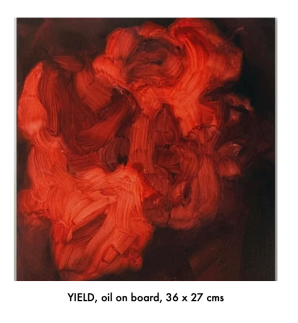
What was the initial spark behind Yield? Was it inspired by a specific experience, emotion, or observation?
All of my paintings begin with a reference photograph. In the case of Yield, the starting point was a red ceiling light. The photograph itself wasn’t particularly in focus, but it had an intense red glow that I was drawn to.
The painting sits somewhere between abstraction and suggestion. Did you begin with a recognisable form in mind, or did the image emerge through the process of painting?
It began in quite a controlled way, as with all my paintings. I worked out the colour palette, light and shadow in my head, then drew the form clearly and accurately. So initially there was a very definite object and structure, in this case a light fitting, but once I began painting, that certainty disappeared. I had no idea how the finished painting would look. The painting happened somewhere between the structure of the original drawing and letting go of it.
The title Yield carries multiple meanings: surrender, produce, giving way, even transformation. What does the word mean to you in relation to this work?
I deliberately leave my titles open. Yield carries multiple meanings. Partly it’s about surrendering to the moment, acknowledging time passing and letting go of something slipping away. It’s also about yielding to the painting process itself, allowing the form to emerge and disappear rather than trying to control it completely.
Red dominates the composition, creating a powerful emotional presence. What role does colour play in conveying the ideas or feelings behind the painting?
I try not to consciously assign meaning to colour at the beginning, although colour itself is very deliberate. With Yield, the source image had an extraordinarily intense red glow. I began with a very red ground, and the painting developed from there. It came at a point when the work I was making for After Hours had been getting progressively warmer in hue, more bodily and more fleshy.
Yield felt almost like a climax of that, the point at which the warmth reached its greatest intensity. Something else happened that I hadn’t consciously intended. Once Yield was finished, I couldn’t escape the sense that the form looked like a large heart. At the time, somebody close to me was experiencing heart failure and was very ill. I hadn’t deliberately chosen an image that resembled a heart. The source photograph was simply a light fitting, but the association felt undeniable to me.
Many viewers may see floral forms within the brushwork, while others might interpret something entirely different. How important is ambiguity in your practice?
Ambiguity is vital for me because the painting is always in flux, never fixed. I often take photos throughout the process to track how it shifts. It’s invaluable because there are moments I miss or that disappear, and having that record informs the next painting. As for floral forms, that ties to the organic, the bodily, the meaty. Even though the reference is not organic, just a light fitting, the final image can carry that dissolving, visceral quality.
The surface of the painting feels highly physical, with visible brushstrokes and layered movement. Can you talk about your relationship with gesture and mark making when creating a piece like this?
The painting process is very physical and intense. It feels like I take a breath in at the start and hold it until it’s finished. The process involves adding and taking away paint, moving it around, rubbing areas out and painting back into them. The character of the brushstrokes can change enormously throughout. Sometimes they grow and take over, other times they stay more refined, and sometimes they become very economical and stripped back.
I don’t plan any of this. I just respond to what is happening in the painting. I need to be completely present. I listen to music and get into a particular state of mind where I’m responding instinctively to each mark as I make it. But the gesture can’t simply be expressive for its own sake. Each mark has to do something within the painting.
There is a tension between fragility and strength in Yield. Is that contrast something you consciously explore in your work?
Absolutely. I think the strength and fragility exist together. There is something very physical and forceful about the paint in Yield, but the form itself remains precarious. The illusion of something solid is constantly punctured by the fact that you can clearly see that it is paint and that it is made from brushstrokes. So although the form has a strong physical presence, it also feels as though it could melt away.
How did you know the painting was finished? Was there a particular moment when Yield revealed itself to you?
Yield took about six hours to paint. The initial form came together relatively quickly, but then I spent a long time on the final stages, moving the paint around. The last hour or so felt like an intense wrestle with the painting. I kept getting close to the point where it felt finished, but not quite. A brushstroke could suddenly become too heavy or too resolved and I would have to go back into it.
There is a very particular point of balance I’m looking for, where the painting makes enough visual sense for the form to exist, but remains spontaneous and fluid enough that it doesn’t become fixed. The difference can be incredibly slight. Just enough really is just enough. When that point suddenly arrives, its brushes down.
What do you hope viewers bring to this painting, and are you interested in hearing interpretations that differ from your own understanding of the work?
Absolutely. I have a fairly clear sense of how my paintings operate, but I’m also completely cocooned within my own process. I’m so close to them that I know I’m inevitably blind in some ways. I’m really interested in what happens when the paintings go out into the world, what other people see in them, the associations they make and the responses they have. I don’t need somebody else’s interpretation to correspond with mine. In some ways, I’m more interested when it doesn’t.
Looking back at Yield now, has your relationship with the painting changed since you completed it, or does it still speak to you in the same way?
My relationship with Yield is still quite similar because when I look at it, I remember the physical and mental intensity of making it, particularly that wrestle during the final hour. I don’t just see the finished image. I remember the process very strongly and the decisions I was making. I can still see that struggle within it, and I think that’s why the painting continues to feel very immediate to me. That wrestle was well worth it though as Yield has been selected with 2 of my other paintings for The Contemporary British Painting prize 2026. I’m absolutely over the moon. The exhibition opens in Sheffield in September before travelling to London in November.
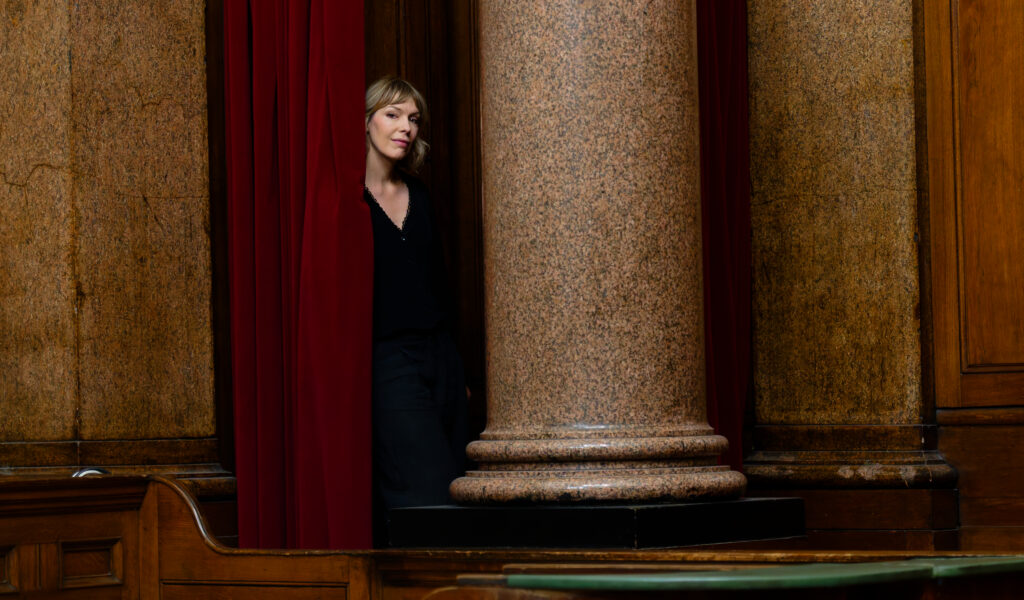
What makes Yield particularly revealing is that, for all its apparent spontaneity, nothing about Caroline Gorick’s return to painting has been accidental. The red light was found, photographed and considered. The form was drawn. The colour was deliberately chosen. And then, somewhere between that initial act of control and the six-hour physical intensity of making the painting, the certainty began to fall away.
Perhaps that is why this painting feels so alive. It contains the evidence of its own making: the decisions, the hesitation, the removal and reapplication of paint, the moments when Gorick came close to resolving it and then deliberately unsettled it again. What looks like an image is also a record of a process, and what looks solid is always threatening to dissolve. That seems particularly appropriate for an artist who spent years wondering whether she was still an artist at all.
Gorick doesn’t describe her return to painting as a calculated career decision. It sounds much more visceral than that. She started again, made tiny paintings, and then found that everything she had accumulated during those lost years was still there, waiting to come out. The work that followed wasn’t a return to where she had left off, but something transformed by absence.
Now Yield has been selected for the Contemporary British Painting Prize, alongside two of her other works, with the exhibition opening in Sheffield in September before travelling to London in November. Once again, her paintings are entering the world beyond the studio, where they cease to belong entirely to their maker and begin to acquire meanings of their own.
True to form, Gorick welcomes that uncertainty. She doesn’t need viewers to see what she sees. In fact, she is more interested when they don’t. It feels like the natural extension of everything happening within the paintings themselves: the refusal to fix an image, an emotion or an interpretation in one place. And perhaps that is ultimately what painting gives her — not the ability to stop time, but a way of becoming acutely aware of it.
A lamp remains still while the world moves around it. A childhood image of Goya survives decades later. A painting changes while it is being made, and survives the moment in which it was created. A brushstroke can be rubbed away, yet somehow leave its trace behind. Gorick is trying to hold onto the moment, while knowing perfectly well that the moment cannot be held…
That may be the reason her work feels less like an attempt to preserve something than an acceptance of its disappearance. The painting exists precisely because everything it depicts is temporary. Its strength comes with fragility; its clarity depends upon uncertainty; its final form is reached only when Gorick finally decides to stop interfering…“Just enough really is just enough…”
For now, that seems to be where Caroline Gorick’s paintings live: in that tiny space between holding on and letting go. Which is a very special place indeed.
Visit carolinegorick.com or follow @caroline_gorickpainting on Instagram for updates.