

Grindr: The Opera! Writer Erik Ransom on Love, Lust and the Search for Connection

When Erik Ransom first began writing Grindr: The Opera!, Grindr wasn’t even the subject. The piece began life as Manhunt: The Opera, inspired by Ransom’s fascination with the wildly contrasting intentions he encountered on early online dating and hook-up sites. Some users were looking for sex, others romance, some something considerably more complicated. Beneath all those different desires, however, Ransom recognised a common thread: connection. With a background in classical music and a taste for camp and kitsch, he began doing what seemed perfectly logical — turning the whole thing into opera.
However, the technology moved faster than the work.
As smartphones began to transform online dating, Manhunt’s world was rapidly becoming yesterday’s technology. Ransom’s unfinished opera sat on the shelf until a friend suggested revisiting it as Grindr: The Opera!. The idea initially failed to ignite, until Ransom realised that the app itself could become a character — an active participant in the lives, desires and misadventures of the men using it. The result was a sung-through musical which turned a piece of technology into something resembling a mythical siren, luring its users towards sex, love, disappointment, obsession and, occasionally, something approaching genuine intimacy. And more than a decade later, the joke has proved considerably more durable than anybody might have expected.
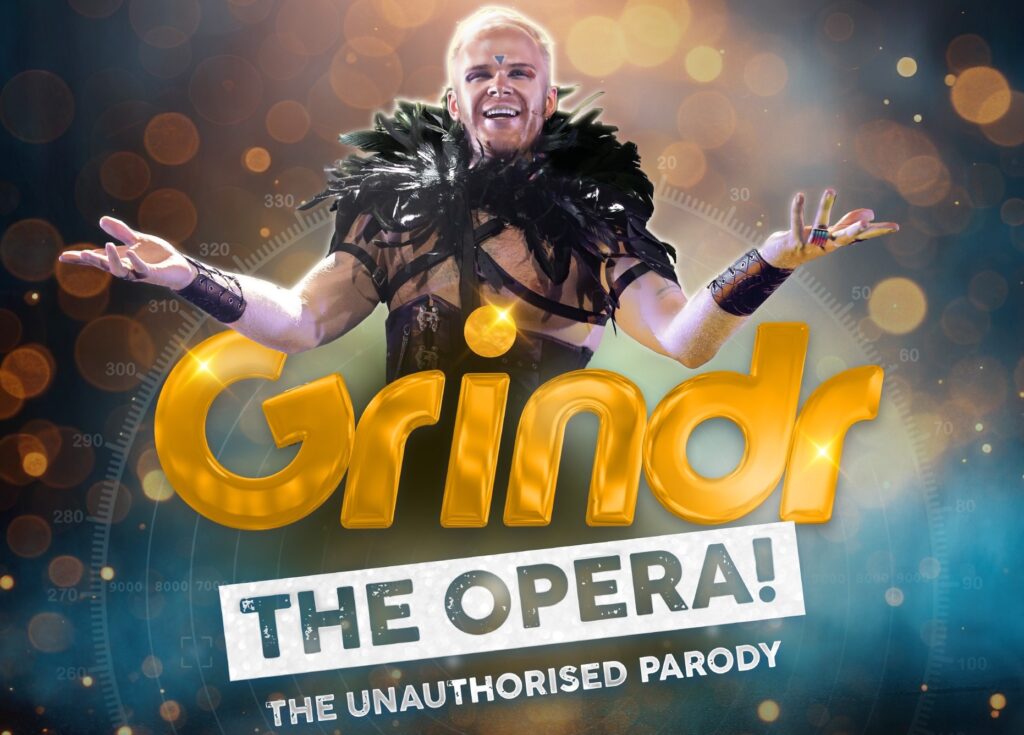
Grindr: The Opera! arrives at Liverpool’s Unity Theatre from 1–5 September 2026 as part of its UK tour, following its London, Birmingham and Manchester engagements. Written by Ransom, with book, music and lyrics by the composer, this new production is directed and choreographed by William Spencer, with musical direction from Aaron Clingham, and produced by Peter Bull for Above The Stag Theatre. The production has already won the Off West End Award for Best New Musical.
The premise may sound gloriously outrageous, but Ransom’s opera has always been doing something rather more interesting beneath the filth, flamboyance and high camp. Four gay men — Devon, Tom, Jack and Don — encounter Grindr while seeking very different forms of connection, allowing the piece to explore identity, loneliness, desire, vulnerability and the ways technology can simultaneously bring people together and leave them feeling more isolated.
And perhaps that is why the show has survived its original technological moment. Dating apps are now so embedded in everyday life that the idea of meeting somebody through a phone is hardly remarkable. What has become increasingly complicated is what happens after the connection is made — and what we reveal, conceal or invent about ourselves along the way.
Ransom’s own experience of watching the production evolve is equally fascinating. The original work was written at a moment when app culture was still emerging; today’s audiences arrive with an entirely different understanding of digital relationships, while issues surrounding loneliness, mental health, sexual health and the increasingly complicated relationship between humans and technology have moved firmly into the mainstream.
For Ransom, though, Grindr: The Opera! has never simply been about Grindr. It is about us. About desire. About performance. About loneliness. About the extraordinary human need to connect — and what happens when we attempt to satisfy that ancient need through technology that changes almost faster than we can understand it. And beneath all the knowing humour, the outrageousness and the operatic grandeur, there is a surprisingly serious question waiting for the audience – in an increasingly digital world, what exactly are we looking for when we reach for connection?
In this Liverpool Noise exclusive conversation with Erik Ransom, he talks about the extraordinary journey from Manhunt: The Opera to Grindr: The Opera! the changing landscape of queer dating, the show’s relationship with sexual health, why humour is essential to its emotional impact, and what he hopes Liverpool audiences will take away from a show he first began writing more than a decade ago…
Grindr: The Opera! began life over a decade ago. Looking back now, did you ever imagine it would still be resonating with audiences in 2026?
Indeed! Many twinks have graduated into zaddy-hood since the early days of Grindr: The Opera!
I was always aware that writing something about a rapidly evolving technology meant there was a risk that the show might have a finite shelf-life. I felt an urgency to get it out into the world as soon as I could back then, lest Gaydar or Scruff usurp Grindr’s meteoric empire. Luckily for us, the brand remains relevant and I’m so very pleased that our show is still resonating with people! Audiences seem to be finding universal themes amidst those originally geared specifically toward Grindr users. I would say that’s actually more true now than it was when I first wrote the piece, as more people are familiar with dating app culture across many more demographics. I think a lot of things that used to be niche have hit the mainstream.
The show originally started as Manhunt: The Opera before evolving into Grindr: The Opera! How much did the rapid changes in technology and dating culture reshape the work during its development?
In the beginning I was wrestling with my own place in the world of online dating. I came of age as a single, queer person on the cusp of the rise of the apps. I remember perusing some profiles on Manhunt.net and other dating/hook-up sites all those years ago and being struck by the diverse and often contrasting goals reflected amongst the users. Like the songs of Grindr: The Opera!, some instances were hardcore and unabashedly sexual, whilst others were vanilla verging on romantic. I found there to be a fascinating spectrum of people seeking wildly different things but with one, common theme: connection. Having a background in classical music and a love of camp and kitsch, my mind naturally took these observations to operatic extremes.
I wrote a lot of the original libretto before I even owned a smart phone and then I lost momentum with “Manhunt.net the Opera” and it sat on a shelf until a friend suggested I revise it into “Grindr the Opera”. That idea didn’t sing for me at first, but then I had the notion to make Grindr an active participant in the antics as a literal character, and from there it flowed like poppers in a dark room. It’s been on a pretty steady course since then and, though many competing apps have risen and fallen in the interim, Grindr remains the only queer dating app I can think of that has mainstream name recognition.
What fascinates me is that the opera isn’t really about an app—it’s about connection, identity and the ways we present ourselves to others. Was that always the heart of the piece, or did those themes emerge as you wrote?
Yes, and I’m so glad you took that understanding away from Will Spencer’s beautiful, thoughtful production! I would say the themes emerged as I wrote. I didn’t outline the story in advance or predetermine how everything would wrap up. I decided on the character archetypes I wanted to reflect and started writing from their mindsets. I wanted to explore the characters’ relationships to the app as well as the connections between the human characters. I think more and more in this age of AI, we’re seeing humanity’s relationship with technology evolve into something unprecedented. It’s definitely something I think society should spend more energy examining as technology evolves much faster than we mere organic lifeforms.
The production brilliantly mixes opera, musical theatre, comedy and genuine emotional depth. Were there any artistic influences that helped shape such an unusual blend?
Thank you! I did actually study opera at university and, though many have observed the show feels more like a musical with classical influences peppered throughout, it does fit the literal definition of an opera. The piece is completely sung-through with no spoken dialogue. Every word of text is notated in the score.
As for influences: The most explicit classical references include Mozart, Puccini, Gilbert & Sullivan and even Wagner, but we also give nods to the Village People and other more contemporary artists.
I do have to also give a big nod to Jerry Springer: the Opera which premiered around the time I was working on my music degree. I found its shockingly irreverent comedy gilded a really brilliant, nuanced, critical exploration of American pop and religious culture. It led with audacity and, from there, managed to pull my heartstrings in many directions I didn’t expect from an opera ostensibly about a trashy, exploitative daytime talkshow. I hope Grindr: The Opera surprises people after a similar fashion.
Since the show’s premiere, dating apps have become almost universal, while conversations around mental health, loneliness and digital relationships have become far more prominent. Do you think audiences read the opera differently today than they did when it first opened?
I do. I think some of what shocked the early audiences has grown more commonplace. Meanwhile, the culture has shifted in such a way that some things I used to take for granted feel more shocking now. It’s been so interesting to watch audiences absorb the show in different times and in different parts of the world. As a city-dweller, I initially took for granted that Grindr had the reputation of which I was familiar. It has since come to my attention that in less populated, more conservative areas or in less queer-friendly cultures, an app I saw as an outlet for sex, dating, etc. might have a very different meaning. There are still so many parts of the world where it isn’t safe to be open about one’s sexuality, and Grindr can become an outlet to connect with other queer people. At the end of the day, all of these apps are about connecting in some way. For one person it might be for a quick sexual release and for someone else it might be a lifeline that makes them feel less alone in an isolating world.
I also find it intriguing that queer people were innovators in an industry that has since gone exceedingly mainstream. First there were apps for gay men, now we have dating apps for everything from hardcore fetishists to fundamentalist Christians! I think part of me wanted to put Grindr on a bit of a pedestal as the queer progenitor to an entire industry that has gone so very mainstream.
I work as a sexual health nurse, and over the many years I’ve seen first-hand how apps like Grindr have transformed not only relationships, but conversations around sexual health, HIV prevention and wellbeing. Have healthcare professionals or people working in the LGBTQ+ community ever shared perspectives on the show that particularly stayed with you?
Oh, absolutely! That’s such important work and I have so much respect for you having done it. All the nurses I know sacrifice so much for a greater good and sexual health has always been an issue close to my heart. I came of age long before PReP, at a time when the spectre of HIV still loomed very large and the treatments were not what they are today. That had an immense impact on my adolescent understanding of sex and sexuality and I didn’t want to ignore its place in the culture I was depicting in this opera. This show has, throughout its development, addressed issues surrounding sexual health in different ways, but it’s always been present. It took a long time to find the right balance for how to tackle it in the show, but I’m happy where things are now and I’ve gotten good feedback from people I know in the healthcare industry. There’s no doubt that PReP and other innovations have been incredible for the community, but they aren’t a panacea. Other STIs exist and we’ve all seen lately how quickly and cataclysmically a pandemic can rise. I think it’s quite remarkable how much HIV/AIDS research ended up benefitting our fight against the COVID-19 virus and I am so grateful to the queer pioneers who toiled against all odds to make those scientific breakthroughs happen. Another example of queer innovation going mainstream…
Humour is one of the show’s greatest strengths, yet underneath the comedy there’s a great deal of humanity. Was it important to you that audiences leave feeling empathy rather than simply amusement?
Very much so! I don’t tend to enjoy consuming art that is made for entertainment alone, and I’ve never been keen to write a fluff piece. Creating a musical is a huge investment of time, energy and heart. I need to really care about what I’m writing if I’m going to sit down for months and spend many lonely hours setting a tale to music. I’ve started so many musicals that never saw the light of day, because they never found their statement or, as in the case of “Grindr the Opera”, their question for the audience. I’ve always felt that humour is a great way to bring an audience in. I think it opens their hearts a bit to investing in characters with whom they only get to spend a couple of hours.
Opera is an exaggeration of real life themes and sometimes that’s funny, but other times it is heartrending. It’s certainly a difficult balance to strike and, given the nature of the show, the humour can seem jarring or insensitive in a production that doesn’t handle the serious themes with their due gravitas. I give so much credit to Dereck Walker, whose portrayal of Don plumbs the emotional depths of a very challenging and complex arc really exquisitely.
I am so grateful to Peter Bull, our UK producer, who has always seen past the risqué jokes to recognise the heart of the piece. He’s assembled incredible teams of artists over the years to mount productions, like this current tour, that make me look like a better writer by fleshing out such a nuanced, specific world within my words. Director William Spencer and Music Director/Orchestrator Aaron Clingham are also instrumental (pardon the pun) in that endeavour.
Every audience brings its own energy. Have there been any particularly memorable reactions—or even unexpected ones—that have stayed with you over the years?
I really love what William did staging the opening sequence in this production. The transition from the prologue invocation into the character introduction sequence has been getting a fun reaction from audiences. I purposely wrote the opening to seem particularly high brow… at least if you don’t know the translation of what’s being sung, so I feel this sense a relief wash over the house as people realise the whole thing won’t be stuffy and aloof. We take a very sharp turn there and it’s fun to watch.
Liverpool has a rich theatrical tradition and a vibrant LGBTQ+ community. What are you most looking forward to about bringing Grindr: The Opera to the Unity Theatre this September?
I spent a bit of time in Liverpool a few years ago and I quite enjoyed the Scouse gay nightlife I experienced! The show has been done a few times in London, but Liverpool has such a different vibe and I’m excited to see how it is received in that part of the country. I never know what to expect from audiences in new areas.
But I would say what excites me most is letting this brilliant cast pour their hearts out for brand new audiences. Christian Lunn and Dereck Walker have essayed their roles since the first production and both of them have found so many fresh nuances to their characters. Christian’s portrayal of Grindr is a true tour-de-force. The character feels inexorable in his body and his soaring voice. The new cast members are also doing brilliant work. They’re adding dimensions to archetypes so they rise above cliche. Liverpool can look forward to the beautiful onstage chemistry and harmonic blend between Patrick Barrett and Kane Verrall, the spectrum of crassness to vulnerability in Will Joel’s portrayal of Jack and the humour and heart of Oliver Cartwright and Will Loader as Grindr’s omnipresent eyes and ears. They all do such credit to the piece! Sitting anonymously in the house and watching something I wrote twelve years ago can be anxiety-inducing, but I always know it is in good hands with Peter Bull and William Spencer.
Finally, after all these years with Grindr: The Opera!, what do you hope someone who has never seen the show—and perhaps knows nothing about opera—will take away from the experience?
I hope they are entertained, provoked and, perchance, aroused! Most of all, though, I hope it gets people thinking. At the end of the day, Grindr: The Opera! is about human connection in an increasingly isolating digital world. There is so much comedy and tragedy to be found in our Information Age, but, at the end of the day, we’re all organisms that didn’t evolve to live in the kind of environment that has come to prominence. Every day we wrestle with that and I think it’s a salient subject well worth contemplating!
Grindr: The Opera!
1 – 5 September 2026
Unity Theatre
Tickets