

Outfits rarely remain static for an entire day. Layers are added or removed, footwear changes, and the context surrounding clothing shifts as plans evolve. In this constant state of adjustment, certain garments take on a stabilising role. Rather than responding to change, they remain consistent, allowing everything else to move around them.
Tailoring, when used in this way, becomes a fixed point in an otherwise changing outfit. This approach reframes how traditional suits are understood. Instead of being treated as complete looks that must be preserved, they function as anchors. Their structure provides continuity, even as other elements adapt to different moments, settings or levels of formality throughout the day.
Stability as a starting position
In contemporary dressing, stability is often undervalued. Flexibility is praised, adaptability encouraged. Yet without a stable reference, constant change can lead to visual inconsistency. Tailoring offers a clear starting position from which variation becomes possible.
A tailored jacket or suit establishes proportion early on. Its lines define the body, creating a framework that remains recognisable even when other components shift. This stability allows the wearer to approach dressing with confidence, knowing that the core of the outfit will hold, regardless of what is added or removed.
Letting the outfit evolve around structure
When tailoring acts as a fixed point, the rest of the outfit gains freedom. Knitwear can replace shirts, footwear can shift from formal to relaxed, and accessories can move in and out without disrupting balance. The tailored element absorbs these changes, maintaining coherence as the surrounding pieces evolve.
This dynamic works particularly well in days that unfold unpredictably. Rather than preparing multiple outfits for different moments, a single tailored base supports variation. The outfit does not need to be rebuilt – it simply adapts.
Why consistency matters in modern dressing
Consistency plays an important role in how outfits are perceived over time. When the central element remains unchanged, variation elsewhere feels intentional rather than reactive. Tailoring provides this consistency through proportion, weight and construction.
Unlike garments that shift character depending on context, women’s tailored suits retain their identity. This does not make them rigid – it makes them reliable. Their presence creates a visual throughline that carries the outfit across different environments, from structured settings to more informal ones, without loss of clarity.
Changing layers without losing definition
Layering is often where outfits lose definition. As pieces are added or removed, proportions can shift unpredictably. When tailoring sits at the centre, these changes become easier to manage.
A tailored jacket maintains outline even as layers beneath change. A suit anchors the silhouette while footwear or outer layers adapt to practical needs. The outfit remains legible at every stage, because its core does not move. This allows for adjustment without compromise, a key advantage in everyday dressing.
Tailoring as a reference, not a rule
Using tailoring as a fixed point does not mean adhering to strict codes. On the contrary, it allows for greater interpretation. When structure is already present, there is less pressure to reinforce it elsewhere.
Casual elements gain legitimacy when paired with tailoring that remains constant. The outfit does not rely on uniformity – it relies on reference. Tailoring becomes a guide rather than a constraint, offering direction without dictating outcome.
A steady element in fluid routines
Daily routines rarely follow a single pattern. They expand, contract and shift as circumstances change. In this fluidity, having one element that remains steady simplifies the process of dressing.
When tailoring becomes the fixed point, it supports movement rather than resisting it. The outfit can respond to the day without losing its centre. Structure remains present, even as details evolve. In a wardrobe shaped by variation, tailoring provides the calm around which everything else turns.
Tailored design at Max Mara beyond formal moments
Design at Max Mara has always been guided by a clear, disciplined idea of usefulness. Since its foundation in 1951, the Maison has approached fashion as a system rather than a series of isolated statements, creating garments intended to support everyday life with consistency and intention. Elegance, in this context, is not defined by occasion, but by coherence: the ability of a wardrobe to remain relevant across different moments, roles and environments.
This philosophy reflects a deep understanding of the women Max Mara designs for. Confident, self-aware and purposeful, they seek clothing that adapts to their rhythm without imposing constraints. Their wardrobes are built around reliability and balance, favouring pieces that can move fluidly between professional settings and more informal contexts while preserving clarity of form and identity.
Over time, this approach has evolved into a complete wardrobe vision. Alongside its iconic outerwear, the brand has extended the same architectural thinking, treating tailoring not as a symbol of formality but as a functional element of everyday dressing. Structure is softened, volumes are calibrated, and silhouettes are designed to accompany movement rather than restrict it.
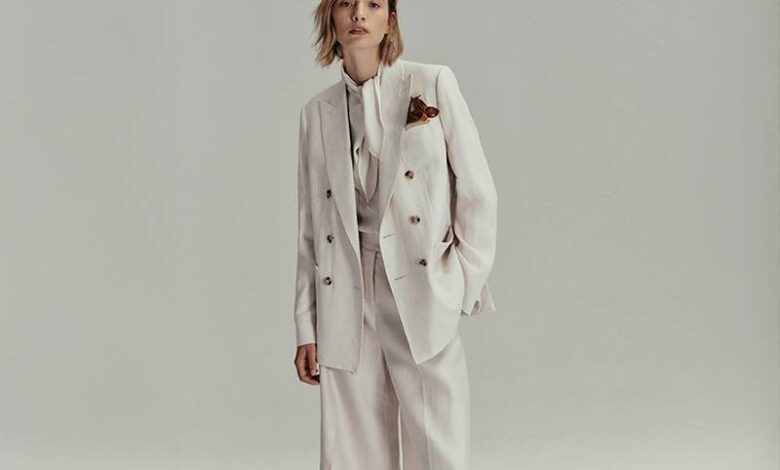
This perspective is fully expressed through the Tailored Suit Project. Conceived as an exploration of construction and precision, each jacket is built around an internal canvas and refined through meticulous hand-finishing, requiring over 345 minutes of dedicated work.
The result is a suit that remains grounded in tailoring tradition while responding to contemporary needs: controlled yet fluid, defined yet adaptable. Rather than being reserved for specific moments, it integrates naturally into a modern wardrobe.
Ultimately, Max Mara’s vision extends beyond individual categories. Each collection contributes to a broader idea of dressing shaped by intention, continuity and respect for real life. By designing garments that function across contexts without losing identity, the Maison continues to articulate an enduring concept of elegance – one that evolves quietly, supports individuality and remains relevant over time.